Pages

Showing posts with label civil service. Show all posts

Monday, 22 March 2021

What the military can teach the NHS about how to get the right things done in the most effective way

Everyone has a plan until they get punched in the mouth

Mike Tyson, boxer


...no plan of operations extends with any certainty beyond the first contact with the main hostile force


Helmuth von Moltke the Elder, 19th century Chief of the Prussian General Staff


The NHS swings between bouts of centralised power in the hands of ministers and decentralised decision making by its regions and units in repeated attempts to achieve its goals. But it never seems to achieve the goals desired. I suspect its leaders (both politicians and bureaucrats) have never learned an important lesson that many military forces learned the hard way.


The current NHS white paper proposes a great deal of new centralisation of power in the NHS, a major reversal of Blair-era reforms which tried to decentralise decision-making. My best guess as to why this is happening is that ministers feel the NHS is not achieving what they want and the only effective way to do so is to take back power. This is wrong. Though it is far from obvious that decentralisation worked either and the real problem is a fundamentally misguided view of how to get things done in a big organisation that has persisted in the NHS for decades.


Other big organisations have taken a different approach. Many militaries learned the hard way how to achieve their goals and how they did so provides useful lessons for the NHS.


The fundamental idea that governs the NHS is that people should "follow the plan" and do as they are told. They should achieve things by following the how of the plan and are frequently judged on whether they follow the right process to achieve the goal. Metrics are often if not usually process metrics not outcome metrics. This philosophy of management (or culture) has persisted over time despite major changes in the structure of NHS management which has swung from centralised to decentralised and back over the last few decades.


This follow-the-plan philosophy is how many militaries used to exercise command and control in their troops. This was how the British military worked at the start of WW2 until the outcomes forced a major rethink. 


A good illustration of the problem is the campaign in North Africa. Until the decisive defeat of the Afrika Corps at the second battle of El Alamein, the British forces were repeatedly defeated by a vastly inferior German and Italian force (the Allied forces almost always outnumbered the Axis forces in men, tanks, guns equipment and had far fewer persistent shortages of supplies). According to the insightful analysis of Stephen Bungay (in his books Alamein and The Art of Action) this was not–as is often reported–because their leaders were better (though Rommel was an excellent tactician) but because the command and control doctrine of the German army was far superior.


A simple way to understand why is encapsulated succinctly by the Mike Tyson quote and at more length by Moltke: rigid plans are derailed by the messiness of reality which discombobulates the plan as soon as the enemy doesn't act as expected. The British army doctrine at the start of the war demanded that soldiers follow the plan, in detail. Junior officers were disciplined if they deviated from it. Following the orders in detail was the goal. The Germans didn't do that. They knew what Mike Tyson and Moltke knew: the details of the plan fall apart as soon as you meet the enemy. Instead, the Germans issued objectives for all levels of command about the key goals rather than detailed plans about how to achieve the goal. All levels of officers were given wide discretion about the how. They were expected to innovate when they saw the reality on the ground as long as they pursued the key goal they had been set. This led to persistently better decision making in actual battles leading to their inferior forces often winning key engagements with the rigid, hidebound Allied forces (at least until the allies had overwhelming superiority).


German command doctrine (now called Mission Command and widely adopted as a central philosophy by the modern US and British armies) was that a detailed plan is derailed by real events (like getting punched in the face or when the enemy doesn't act as expected in the plan) so tactical innovation in response to reality is far more likely to achieve the goal than blindly following the details of out-of-date orders cooked up by commanders a long way from the action.


But this is pretty much how the NHS works. Goals are not set in terms of outcomes but in terms of following the plan. Do things the way the centre tells you to. And suffer punishment if you deviate from the process, which we will measure. And they won't measure the outcomes because that is far too hard to measure in the short term. The centraising plan will make this worse, not least because it is the equivalent of a frustrated Churchill demanding direct control of the deployment of individual tanks in the desert because his generals were not winning their battles. The NHS has rarely tolerated local innovation that delivers better outcomes and often seems to regard innovation as "rocking the boat" or "deviating from the process".


This is a critical failure. Unless the NHS radically changes its management philosophy and culture from one where following the plan is rewarded to one where local leaders are rewarded for achieving better outcomes by innovating, it will never get better at achieving better outcomes however the overall structure is changed. 


The NHS plan should focus on the management culture not the structure. It should define the broad goals (outcomes) desired by the government or the leadership and leave the front line leaders to find better ways to achieve those goals. And it should radically cut the process ("do things this way") metrics and use more achieve this outcome metrics. And don't forget culture change: culture may reappear and control the results even if the structure is new. A change in management structures will always be trumped by a persistent management culture.


It cannot be said that the military have always remembered this lesson. An analysis of the army's poor performance in the second Gulf War pointed out that Mission Command is not very useful when you have no idea what your mission is (see the introduction to The Good Operation which also has other useful conclusions about public policy that don't seem to have influenced the NHS plan). Perhaps this too is a problem affecting the NHS. Which suggests that the NHS might have been better analysing why it frequently fails to achieve better outcomes before writing a plan that reinforces the very cultural problems that make innovation and flexibility so difficult.


Tuesday, 6 February 2018

We should design A&E statistics to help improve the system not to make it look better than it really is

The desire to make A&E performance look good is in conflict with the need to improve it. The idea that we should report system performance (as David Nicholson argues) is a mistake. We should understand how the system actually works and measure the numbers that most help focus improvement effort.

The problem with the statistics on A&E performance goes far deeper than worries about fiddling the data to get better reported numbers. The real problem is the conflict between the political need to report the best performance and the management need to know what is happening so they can improve performance. The two are in serious conflict in a way the system has never fully acknowledged.

The political desire is report something, preferably something good. The management need is to report something useful for directing management attention to actions that will lead to improvement.

The conflict arises because essentially all the performance problems are in major A&E departments so reporting a combined number (including minor units) distracts attention from the units where performance is worst. For management purposes we might as well ignore all the stand-alone WICs and MIUs as they almost never see waits longer than 4hr. We should report their performance, but we should report it separately to avoid confusion about where the problem is.

The political argument is that emergency care is a system and we should report the overall performance of the system. But this is based on a fallacy. Originally, MIUs and WICs were intended to relieve "pressure" on major A&Es who would, as a result, show better performance. This failed for two reasons: one was that there was no evidence that they diverted a notable number of patients away from major A&Es; the other insight (only available after better data was collected from everyone) is that, even if they had succeeded in diverting patients from major departments, this would not have improved performance in the major A&Es (the divert-able patients are not the ones with long waits even in major A&Es).

What this means is that there are really two systems out there not one: major A&Es (type 1 departments) and units handling minor conditions (type 3s). They don't interact enough to be considered a single system. So they shouldn't be measured as a single system because that just creates confusion about where the problems are.

(There is a slight grey area where a type 3 unit is closely associated with a major A&E. In many of these all the minors are diverted at the front door to the type 3 unit. But this is exactly how a well functioning type 1 A&E should behave internally anyway (minors should be streamed to a simple and fast process) so it seems a little odd to separate the two for reporting purposes. This only applies when the units are co-located.)

The big conflict comes when hospitals are allowed to count remote WICs and MIUs in their headline performance. The only benefit of doing this is political: it makes the overall number look better. It causes immense confusion and inconsistency in headline performance, not least because some hospitals can do it and others can't making any performance comparisons unfair. Worse, some hospitals have wasted large amounts of management time trying to grab control of minor units so their headline numbers improve, a change which makes precisely no difference to any patient's experience but wastes a lot of management resource in pursuit of window-dressing not actual improvement.

It is unclear what the recent changes mean to all this. In the current reports it is normally possible to extract pure type 1 performance if you want to see it (though it isn't the headline number reported). If the new rules allow less transparent reporting of numbers from minor units they are clearly obfuscatory and bad for the system.

David Nicholson (the former head honcho of NHSE) doesn't agree. He claimed in this tweet that the 95% target was a system target, was was correctly set at 95% and would have been set much lower if it was intended to cover type 1 performance only. But he needs a history lesson. The original target was set at 98% and was only reduced to 95% when the incoming coalition government realised that abolishing the target completely would be a catastrophe. And there was no convincing clinical argument for the change (the original 98% was to allow for a small number of clinical exceptions–concussions, for example–where patients needed to be observed for more than 4hr before discharge). Yes, some medics thought the target was too strict, but they had no evidence-based clinical reasons for this: they believed, naively, that a more relaxed target would be "easier" to meet. They were wrong: before the target was changed the system was exceeding it; as soon as it was changed performance declined rapidly and frequently failed even to meet the new–supposedly easier–target.

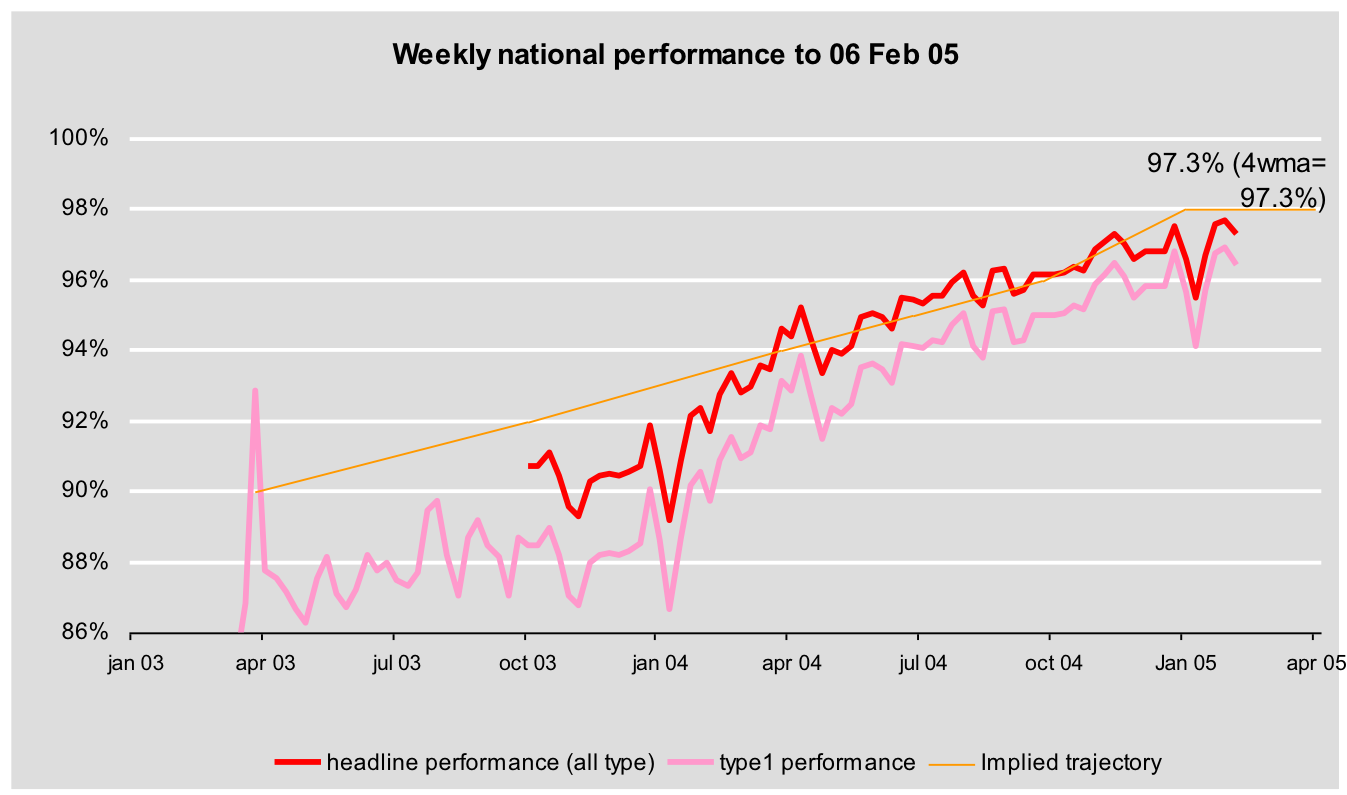
It is also worth noting how the system performed when the original target was set. I extracted the chart below from my archives (I provided the internal weekly reports of national performance to the A&E team for several years after the target was first set: the chart comes from a public presentation I did; sadly I don't have access to the detailed data any more).


The system as a whole eventually met the 98% target for several years. And the type 1 performance often met the 98% until 2010. Moreover, the dilution effect of including the non-type 1 units was small when the type 1 performance was good. It is also worth noting that the decision to publish the system performance (including non-major A&Es) was challenged by analysts who knew that the focus needed to be on major A&E departments. The politically-minded civil servants disagreed and decided to publish the system performance but compromised by including the type 1 performance separately in internal reports to support more focussed improvement interventions.

While consistency is a good thing to aim for (this is the excuse for the changing rules) we seem to be aiming for a fake consistency. WICs and MIUS are not evenly distributed so consistent aggregation of numbers creates an inconsistent and unfair view of actual major A&E performance in different hospitals. By far the easier way to achieve real consistency would be to focus on major A&Es only and ignore the rest (or report their performance separately). That would be consistent and fair. But performance would look much worse.

The same is true for other, related, statistics on A&E performance. England also publishes a 12hr wait statistic, but this is incredibly misleading because it isn't an end-to-end metric. The clock starts when the hospital makes a decision to admit the patient, which many don't make until they know a bed is free meaning that the patient may already have waited 12hr before the clock even starts. Wales and Scotland start the clock when the patient arrives, which isn't gameable. This has confused the Prime Minister who incorrectly compared Welsh and English numbers during PMQs, drawing criticism from the chair of the UK Statistics authority, not least because there are about 100 times more end-to-end 12hr waits in England than the published number quoted by the PM suggested (as I explained here).

Real 12hr waits are actually measured in England just not published. NHS Digital now release them (but infrequently) and few NHS managers seem to know they exist or use them despite the important additional information they provide supplementing the reported 4hr performance. They are very embarrassing as they highlight just how badly A&E performance has deteriorated in the last 8 years. So embarrassing that I was once fired for impetuously talking about them in public (I shouldn't have done but I was naively trying to improve the quality of the debate about A&E performance using actual data).

To summarise. The real problem isn't fiddling the numbers: it is choosing the wrong numbers to look at in the first place. The need to improve performance is in conflict with the political need to report the best performance possible. We should report the numbers most useful for driving improvement (type 1 4hr and 12hr performance) not the ones that confuse us about where the problems are.


PS when private sector firms do this with their performance numbers it usually ends up in disaster. Enron and Carillion, for example, used clever ruses to make their public headline financials look better than their real underlying performance. In the end their managements fooled themselves. Eventually, the real situation became apparent, but far too late for anyone act to avert disaster.


Friday, 18 March 2016

The government approach to cutting costs is the worst way to achieve lower costs


Governments love to distribute the pain of budget cuts evenly by slicing a percentage from every department's budget. This seems fair but is the worst way to achieve sustainably lower spending or to minimise the damage caused by the cuts.


The trouble with government is that it is run by politicians. And politicians usually care more about image than they do about substance when it comes to making decisions. So when public finances are squeezed they tend to focus on the fairness of their budget cuts rather than the effectiveness of their budget cuts and this sometimes leads to really dumb decisions.


To do a good job of cost cutting or improving efficiency you need to know where and how the money is being spent now. For example, if you run a factory and its costs are way higher than the competition, it helps to know in detail why that is the case. It could be you have a serious problem with overmanning; or it might be that the skill mix is wrong and you need higher quality, more productive people; or, it might be that you need more people because the machines they work with are unreliable and old; or perhaps you buy all the raw materials from low quality, expensive suppliers. If you don't know which problem you have, cutting the budget might make things worse not better. If your problem is obsolete machinery, for example, the best fix is to invest in new machinery (which involves spending more); short term cuts to the maintenance budget will, ultimately, lead to less reliability and higher costs.


If the first thing you cut is the accounting and analysis department (they don't produce anything, do they?) then you will not be able to diagnose why your costs are high and therefore tell which action is most important for the long term future of your factory. You will most probably make the wrong decisions.


This is a pretty good analogy for how governments cut public spending.


The ONS, for example, is responsible for gathering and analysing the statistics that tell us what is happening in our economy, but they haven't been doing a good enough job (see BBC story or this story in Public Finance ). But government has been cutting their budget and doing crazy things like moving their headquarters to Newport from London (which saved costs by ensuring that most of their experienced staff resigned to stay in London leaving the organisation with a huge experience deficit and a much reduced capacity to do its job).


The NHS as a whole has done relatively well compared to most other government departments with its total budget. But inside the NHS a similar pattern emerges.


NICE is responsible for evaluating the quality and cost effectiveness of drugs and procedures in the NHS. But it is facing significant budget cuts even though spending more might identify more opportunities to save costs and improve quality across the whole NHS. But we can't have more spent on analytics when there are squeezes on providers, can we? That would be unfair.


The new NHS Improvement is supposed to work alongside NHS providers to help them do a better and more efficient job of caring for patients. There is a strong case for doing more to identify good practice and help spread it across the system. But one of the barriers to achieving improvement is a serious lack of reliable data about how the money is spent now and, in many providers, how the staff are deployed. The Carter review of the opportunities for NHS savings was very clear on this (see this analysis). And it isn't as if the current archaic infrastructure of collecting data in the NHS is good enough to support improvement at any level (see this comment). But NHS Improvement is going to have to live with significant headcount cuts when it is finally officially established. Apparently it needs to send a signal to providers about the fairness of the NHS financial squeeze. And that is, apparently, more important than its ability to do a good job of supporting the NHS to improve.


And it isn't as if hospitals will be expanding their information departments in the current climate even if doing so might help them achieve improvement elsewhere. Cutting already inadequate information teams is easy as it doesn't affect patient care tomorrow (and if it is catastrophic for care in a couple of years, who is going to care as the Chief Executive will have moved on by then?)


If you don't understand how things work, arbitrary cost cutting will lead to long term damage


If your approach to cost cutting involves slicing the ends of everything that looks like a salami then you will also cut the ends off a lot of fingers.


In one of the very few good books on business strategy, Richard Rumelt argues that the first step in any effective strategy is a good diagnosis of the problem you are trying to solve (see this interesting analysis of how his thinking applies to the NHS). The current symptom we observe in the NHS is large financial deficits. But this isn't the problem any more than a fever is a problem for a patient with malaria. To understand what the actual problem in the NHS is we need to know where and how the money flows. If we don't understand what is happening to create deficits then we can't develop a coherent plan to create an NHS that can sustainably treat patients without lapsing into periodic financial catastrophe. We can treat a fever with an ice bath, but if we don't understand what caused it (was it malaria or was it viral pneumonia?) the patient's recovery will be brief and the fever will soon return.


I don't want to try and diagnose the underlying problems of the NHS in a short blog article; my point is merely that a salami slicing approach to budget cuts damages the system's ability to do diagnosis. This is especially true when the cuts affect the flow of information or the bodies with the expertise to analyse problems and develop improvements. The NHS has tended to grossly undervalue good, timely operational information and is severely short of the analytical capacity to make sense of that information (for examples see this on A&E data and this on the information infrastructure).


The Carter report on hospital productivity argued (see my analysis) that the biggest barrier to improvement was a lack of good information about operational performance. But the we-must-share-the-pain-equally, salami-slicing model of addressing the current deficits is cutting the capacity to collect and analyse that information even though that capacity was inadequate to start with.


We won't build a sustainable NHS without a good diagnosis of the underlying problems. That requires better information about what is happening inside hospitals. A good strategy for achieving a sustainable NHS would, therefore, focus on getting better information at the start so subsequent decisions could address the most important underlying problems.


What we are likely to get is more salami-slicing which damages our ability to understand the problem and exacerbates the failure to focus on which problems matter most. In fact NHS strategy is still in an era equivalent to medicine when bleeding patients with leeches was still thought to be a good universal cure. As in medicine, repeated application of the leeches will fail to cure the patient. Whatever the apparent short term gain, in the long term the patient will be sicker.


The problem generalises across all of government. Salami-slicing cuts to everyone's budget damages the government's very ability to know what is actually happening and therefore its ability to make good decisions about what really ought to be done.


It looks like the patient with the fever is stuck in the ICU until someone comes up with a better diagnosis.


Sunday, 16 August 2015

Government needs to develop better ways to make spending decisions

Government's’ failure to understand return on investment is catastrophic when budgets are being cut

The recent announcement of a new rounds of cuts to public health budgets (see the Kings Fund analysis here) has highlighted something rotten in the way government makes spending decisions. It smacks to me of something I’ve suspected for a long time: governments don’t have a sensible, logical or reasonable way to make good decisions about where and how their money is allocated.

The issue isn't as simple as “evil tory cuts” (though that is how many headlines will portray it) because Labour governments have also shown the same underlying failure to understand the difference between good and bad ways to spend their (or, as some would say: your) money.

The difference between Labour and Conservative ideas is often portrayed to be between those who want to spend more and those who want to spend less. Though both flavours of politician in the UK have run the country at times of both austerity and plenty and both have presided over regimens where both more spending and less spending have been appropriate. Both, however, have failed to show much insight into how to make the decisions about where the money ought to go.

There are several parts that contribute to this failure. One is that most government decisions are made top-down; they worry about the totals but not the details. Another is that many decisions are essentially political: that is they are determined by what looks good rather than what actually works. Inertia plays a role: once started many government activities are hard to stop and radical shifts in the allocation of money are hard to make. Fragmentation of decision making plays another role: the impact of decisions in one department on the costs in another are rarely considered carefully. Overall the impact of spending is rarely a serious part of decisions about the amount of spending (let’s call this a failure to understand Return on Investment (ROI) even though I’m broadening the terminology beyond its normal use in business).

In simple language there is certain tendency in governments spending more to believe that the only thing that matters is that more is spent. And those governments pursuing cuts tend to focus on the headline departmental budgets with little consideration for the long term effect on either outcomes or even the impact on total government spending in future years.

Businesses don’t do decision making like this. Or, to be more precise, those businesses who do make bad decisions persistently get driven to bankruptcy by the competitors who make better decisions. Governments lack this corrective mechanism and can persist with utterly rotten decisions on a scale impossible in even the largest private enterprise. In fact, while private sector firms are ultimately disciplined by competition and have to correct bad decisions or fail, governments have a built in tendency to never admit their failings--that looks bad in headlines--and therefore persist with bad ideas for much longer and on a larger scale.

The point I want to make is that good decision making in many businesses has characteristics that are frequently absent in government. In particular, successful businesses are good at considering the effect on the whole business of each spending decision. And, they tend to be smart at recognising when more spending in one area will lead to lower cost or greater success in another.

The core problem is that not all spending is equal; not all projects deliver the same results; not all budgets have an equal impact on their desire outcomes. Effective decision makers know this and direct their money towards the places where the biggest bangs per buck are achieved (or the return on investment is highest). This principle applies whether the money available to spend is plenteous or tightly constrained.

Another, more subtle point, is that the relationship between what you get and how much you spend is far from linear. Sometimes there is a minimal amount that must be spent to achieve anything; sometimes spending twice as much gets you little more than spending the right amount; sometimes a small spend in one area releases the possibility of a large benefit somewhere else.

Take the world of supermarkets. They succeed when the put the right goods on their shelves, at the right time, at the right prices to please their customers and do all this without spending an excessive amount on the logistics of the process. Supermarkets do this well not (just?) by screwing their suppliers on price but by having excellent logistics processes (which, in practice, means a lot of spending on tightly integrated IT systems to coordinate the whole supply chain from production, through delivery to shelf-stocking.) They are well aware that to succeed with customers means spending a great deal of money on things that don’t obviously have anything to do with customers (like IT and logistics).

In contrast, governments are often oblivious to the need to spend here to achieve a benefit there. They tend to impose blanket cuts across all departments when they need to cut back rather than asking whether increased investment in some areas could yield savings somewhere else. Hence cuts in public health spending when the NHS is faced with growing amounts of illness. Or cuts to the ONS when the government is already seriously lacking in good quality information about what is happening in the country (in fact, how does government work out whether any policy is working when its information about outcomes is poor to start with and the budget to collect better information is being cut further?)

The NHS is a microcosm of government kakistocracy here. To know whether the treatments offered by hospitals and GPs are any good we need vast quantities of high quality information about activity and outcomes. We get very little of either as NHS spending on data collection and analysis is a shockingly low outlier in the world of large organisations (headlines are made by declaring that a larger share of the money will go to “frontline care” when we are not prepared to spend the basic minimum to ensure that we know whether that frontline care is doing good or causing harm). Worse, the really big opportunities to improve the NHS are not in major top-down changes to the organisation or public behaviour but in the steady accumulation of small good ideas about how to do things better at the front line. But the only way to achieve cumulative improvement is to monitor activity and outcomes carefully (which means spending on data collection and IT) and to use this information to drive behaviour towards the things that work best. If we really wanted to save money in the NHS (and/or improve the outcomes) we would invest more in data and analysis with the benefit that medical practice would improve over time both saving money and leading to better results. Neither the naive belief that just spending more will make things better nor the opposite belief that cuts should come from somewhere other than the front line actually help much at all (we’ve tried both in the last decade).

Only a careful analysis of which spending will yield system-wide benefits will give a good return on investment in the NHS. So cutting public health budgets is easy to do but may cost more for the NHS as a whole in the future (probably: there may well be many public health projects that have little effect on outcomes or NHS costs but it is fairly clear that the recently announced cuts were not based on any such analysis). adding more staff to the NHS improves capacity but lowers productivity making it a worse investment than spending more to automate the tedious data collection that is often paper-based and wastes vast amounts of medical time.

The general point for government is that thinking about ROI is essential both when budgets are tight and when they are generous. Spending money on the wrong things yields far less benefit that it should; cutting the wrong projects yields far lower savings for government as a whole than it should. Discriminating far more carefully when spending decisions are being made (both when cutting and expanding the budget) could give major gains in how well public services work. Yet there is little evidence that this thinking is part of the way decisions are made on public spending.

Sunday, 28 June 2015

Governments need to get better at recognising when they are wrong

Governments and their civil service advisors need to learn how to admit failure. If they could, their policies would be better and their big capital investment programmes might be more successful. I’m not optimistic.

Apple is sometimes though of as the firm that can do no wrong. Their current position as the most valuable quoted firm on the US stock market is often ascribed to their uncanny ability to create exactly the product consumers really, really want.

This view is wrong and the reason why contains a valuable lesson for governments and their civil service advisors.

I’ll stick with the history of their most successful product to make my point.

When the iPhone was launched I was something of a skeptic on whether it would be successful. I’m a big fan of the Legendary Don Norman (famed for his work on design such as The Psychology of Everyday Things). Norman makes a powerful argument that generalist devices do a worse job of all their tasks than specialist devices. So a computer that tries to be a phone looked like it would be both a bad phone and a bad computer.

Norman was wrong (at least about the iPhone) and so was I.

So, when Apple launched the first iPhone, I didn’t want one, especially at the price. I did eventually buy one but only when the UK suppliers were clearing out their original stock to make way for the iPhone 3G. I think I paid £150, probably 30% of the original launch price. I wasn’t just a skeptic on the features, I really didn’t want to pay their OTT asking price.

The public agreed with me on the price. As, eventually, did Apple, who lopped a third off the original price and, if I remember rightly, offered refunds to some original purchasers to assuage their anger that the price had been dropped.

The important thing is that Apple learned from their error on pricing and, as far as I know, have never had to clear out significant volumes of obsolete stock for any later iPhone model.

Apple has made a whole series of about turns on what looked like set-in-stone features on the iPhone. All this despite the famously and tyrannically opinionated views of Steve Jobs. Originally they were not going to have native apps (it was all going to be WebApps or something). They changed their mind. Originally the form factor was the perfect size for the hand and wasn’t going to change (they based this on solid original research). But they have changed that twice, despite Steve Jobs declaring the original screen size to be perfect.

The point of these changes is that Apple knows how to learn. They don’t have a magical ability to get things right but they really know how to adapt. And they do that quickly. They admit their errors and change. Even while the famously stubborn Jobs was still alive and in charge, they didn’t just stick with what he originally thought of if the evidence said it wasn’t working.

Governments need to learn this skill.

There are two reinforcing pressures that prevent governments from learning. One is the nature of political promises. Political parties base their manifesto promises on the assumption that they know the answers to problems. And the civil servants who advise them when they enter government are promoted and rewarded not for solving problems but for not being seen to fail.

The consequences of failing to admit failure are large. Many (perhaps most) real world problems require a degree of experimentation. Even with the vast effort and the best available research the correct solution to a problem is often far from obvious. Apple may (in retrospect) have radically changed the world of mobile phones but they they only did so after several stumbles and they did so because they were willing to admit their mistakes and change direction.

Private firms have some external discipline to help them. If they continue to resist learning, they will eventually run out of customers and money, limiting the scale of their errors. It isn’t that they make fewer mistakes than governments, but that discipline keeps the scale smaller. Nokia and Blackberry (or RIM as the firm was once know) thought their technical superiority would help them retain market share in mobile phones. They were wrong. But their error didn’t stop the public buying phones, we just buy them from Samsung and Apple. Apple once thought they would change the world of handheld organisers with the Newton, but they had to stop making them before the losses bankrupt the whole firm.

Governments don’t have such external discipline. as a result their mistakes last longer and are bigger in scale. John Kay once described Britain’s attempt to build a new technology (the Advanced gas-cooled Reactor or AGR) for nuclear power generation as the worst public investment in the history of government. The promise was that the UK would have a world beating new technology, invented here and under our control. This could be sold to others and would be a showcase of British technological expertise (unfortunately this came true as the programme was a showcase of how bad Britain’s government is at developing and exploiting new technology). The programme ended having spent perhaps £100bn on a technology that didn’t really work, dwarfing by a factor of 10 the joint French-British investment in the supersonic flight vanity project Concorde.

The AGR programme wasted so much because there was no point where any advisor or any minister wanted to admit it was a failure. It is like a perfect case study to illustrate the sunk-cost fallacy.

Sadly governments are prone to making mistakes that are bigger than they should be because they can’t admit they are wrong. Examples abound: he National Programme for IT in the NHS; The Post Office basic bank account and benefits system; the Crown Prosecution Service’s case tracking system; the Department of Local Government’s FiReControl project to reorganise emergency control rooms and systems. Many of these went wrong for multiple reasons (as documented in The Blunders of our Governments) but an inability to admit errors made them bigger and more damaging.

Policies that don’t have much of a sunk cost also suffer from this delusional assumption of omnicompetence. Tim Harford argues in his book Adapt that, in a complicated world, the only effective way to know what works is to experiment. But this isn’t easy in government. How many manifestos say: we will reform education by trying several different ways of teaching reading and adopt the one that gives the best results? Or: we will try several experiments to test which interventions are most effective at helping people out of poverty?

But even when experiments are sanctioned by government, the motivation of their advisors may undermine their value. The problem is that proper experiments inevitably generate failures. We try several ideas and some work much better than others (if we don’t test a variety we cannot know which is best). So some of them will fail. This admission—that some interventions work better than others—is an essential part of learning. But admitting failure is not in the DNA of most civil servants (at least in the UK). When they do experiments they like to set them up so they can’t fail. Or they do their utmost to avoid admitting they have failed. Either approach utterly inhibits the ability to learn and therefore the ability to improve.

Governments have to get better at this. The world is too complex to be dominated by ideology or by those who think they know the answer before they have tested whether it works.