
Pages

Showing posts with label bed management. Show all posts

Friday, 24 January 2025

NHSE took the blue pill


In the movie The Matrix, where people live in a fake virtual world, Morpheus offers Neo a choice. He says, “You take the blue pill... the story ends, you wake up in your bed and believe whatever you want to believe.” But taking the red pill means you wake up in the horrifying real world and have to face the consequences.


As far as I can tell NHSE took the blue pill.


They seem committed to ignoring the horrible real world of NHS problems and, as a result, seem incapable of fixing the problems.


For example, look at the draft plan for emergency care.


NHSE’s leaked draft plan demonstrates only one thing: they don’t understand how to fix emergency care. They are still stuck in the Matrix.


There are not enough anglo saxon profanities that can express how much contempt I have for their draft plan.


According to the HSJ it proposed the following actions:


  1. Improving vaccination rates and targeted preventative winter virus care.

  2. Reducing 111 calls put through to 999 or directed to ED

  3. Improve Hear & Treat, See & Treat, and Reduce Avoidable Conveyances

  4. Reducing ambulance handover delays

  5. Rapid triage at the front door to navigate patients quickly to the right care and avoid admission wherever possible

  6. Getting into a hospital bed more quickly for those who need one

  7. Improving access to specialist out-of-hospital provision

  8. Shorter Length of Stay

  9. Reduce discharge delays

  10. Standardising and scaling the six core components of neighbourhood health

This is pure blue-pill thinking.


It is so wrong on so many levels that I cannot hurl enough abuse at it.


To see why, let’s start with two things necessary for good, effective strategies. A good diagnosis of the biggest cause of the problem (you can only do this if you take the red pill). And a strong focus on the actions that will tackle that problem. I’ve pointed this out a lot. Nobody in NHSE, it seems, is listening.


The symptom of the problem is that far too many patients are waiting for excessively long times to get through A&E departments. There were 1.7m waits longer than 12hr last year when there should have been fewer than 0.8m waits longer than 4hr in major A&Es. It isn’t even clear that the NHSE leadership know that the problem is in major A&Es (if this speech by Steve Powis, the Medical Director, is any guide–for critical analysis of what he said see this Bluesky thread).


Worse, the leadership have fought against any admission of the most important consequences of those long waits, a large number of excess deaths (the EMJ analysis of this was published in 2022 but the leadership denied the credibility of the results; the ONS update of that analysis published last week suggests the problem is much worse but the presentation of their results omitted relevant data as if to avoid easy comparison with the EMJ estimates). NHSE overdosed on blue pills here.


It isn’t as if the dominant cause of long waits and poor A&E performance has not been analyzed before. The team that originally delivered 98% of waits in under 4hr in the early 2000s said the primary problem was flow through beds. When the post-Lansley performance declined rapidly, several thorough analyses said exactly the same thing in 2015 (eg this). As part of the new strategy for fixing emergency care in January 2023 NHSE repeated these analyses and reached the same result. The primary cause is poor flow through beds. Attendance is irrelevant. (it might be worth noting that NHSE had to be strongarmed into doing or publishing that analysis by No. 10. It wasn’t just that they didn’t volunteer to do a root cause analysis before trying to develop a solution, they resisted doing the analysis. They wanted more blue pills.)


So, in principle, NHSE know these two truths about the causes of the problem:

  • Attendance doesn’t matter and isn’t the cause

  • The problem is flow through beds


These are the biggies. Some debate often claims other factors are issues, like staffing. But we have analysis of most of them and they are not big contributors to the problem (staffing levels, like attendance, have no relationship to performance across a very wide range of different staffing levels in different departments.)


So how do the 10 points in the draft plan stack up against those two, critical, facts? At least for those who didn’t take too many blue pills.


Five of the points are about reducing attendance. Some are perfectly reasonable actions that would achieve good things (who wants lower vaccination rates?). None are remotely relevant to the problem of improving A&E. None would contribute a female gnat’s testicles of better performance in A&E.


The other points might superficially look like they are dealing with the problem: Reduce ambulance handover delays; speed triage; lower LOS; speed admission to beds; reduce discharge delays. But all are either restatements of the problem or demands for improvements in the metrics that measure the problem. None are actions that might tackle the problem.


Apparently the strategy is to ignore the problem. And that is the entire strategy. The blue pills have done their work.


Fuck me this is bad.


Even if the draft is merely an outline and there is some document with scores of pages of concrete ideas behind each bullet point, this is a truly bad place to start. And the track record of those longer “strategy” documents does not suggest that longer is better. 


Here are the first steps I would take to generate improvement. Take the entire team responsible for writing or commissioning this draft and let them take blue pills so they can drink fake wine in a fake restaurant serving excellent perfectly cooked steaks. Maybe they can write off the cost of the fake reality as part of the ambitious plan to do more AI.


And find another team willing to take the red pills and solve the actual problems that continue to exist in the real world.


Tuesday, 16 January 2018

Political bullshit with numbers is making it ever harder to make good decisions


If governments want to make good decisions they have to have reliable data about what is happening. But they increasingly don't use numbers that way. Instead of using data for insight they use it for bullshit and undermine the evidence they need to make a difference to anything.

So the NHS is having a winter crisis. This year instead of the service responding in a panic when the unpredictable event of winter occured, the panic response was, apparently, planned. Apparently, this is good, our lords and masters said so.

But there is a little vignette that occured in Parliament that illustrates a great deal about why we have such problems and even more about the reasons why we currently look like a kakistocracy. It relates to the statistics about bed occupancy in hospitals and illustrates something profoundly disturbing about how politicians handle statistics and use numbers.

The background to the story is that the government has now mandated daily statistics about "winter pressures" in the NHS. That might not be a bad thing in itself if the point were to make management decisions in response to the numbers (though this supposes an ability to know what response to make and to interpret the numbers correctly: neither are obviously true).

One of those statistics is bed occupancy. This isn't a very useful statistic (as I've argued before) but collecting it daily is much better than weekly or monthly which is what is done for the rest of the year.

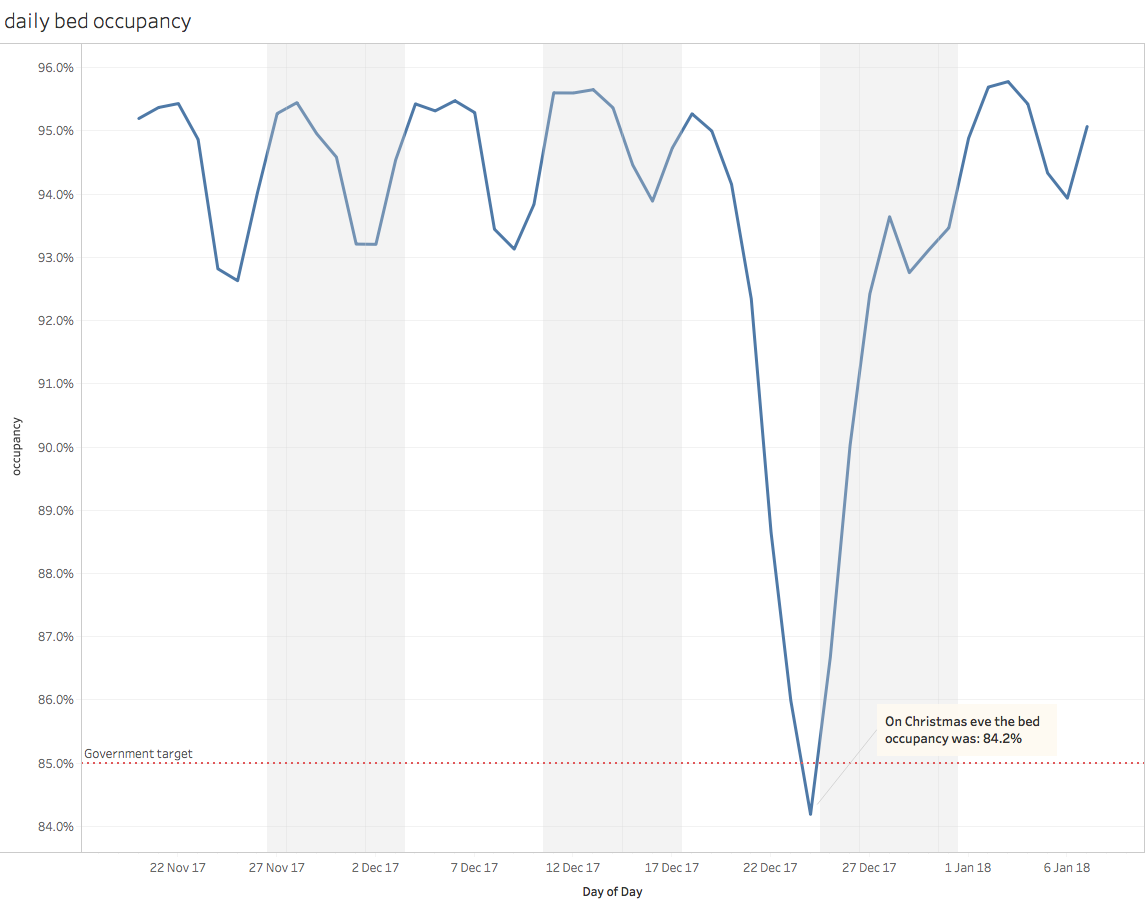
The government (and many others) have set a "target" level of occupancy for beds to ensure there are enough free beds each day to cope with demand. That target says no more than 85% of beds should be occupied.

So far so good. But the annoying doctors and opposition insist we are in the middle of a crisis in bed availability and keep complaining. In response to one of those complaints and in explaining the impact of his winter plan Jeremy Hunt said this in the House of Commons:
The shadow Health Secretary told The Independent: “It is completely unacceptable that the 85% bed occupancy target…has been missed”. What was bed occupancy on Christmas eve? It was 84.2%, so this had a real impact.

To put his claim in context, here is the chart of daily occupancy to early january (from the latest data I could get from NHS England). Shading identifies complete weeks:


Which number did Jeremy Hunt repeat? The least representative number on the chart and the only day in the whole of winter where the target was met. He also ignored the longer term context. The days near christmas have the lowest occupancy of the whole year and, historically, have often been in the 60% range.

Now maybe he was just having a bad day and didn't mean to quote something so irrelevant to the current problems with beds. But another minister said this two days earlier when challenged with a similar complaint in the Lords:
The noble Baroness talked about bed occupancy. Of course, we know that high levels of bed occupancy are a concern. Bed occupancy was below the target of 85% going into this period—on Christmas Eve it was 84.2%
I think we can conclude that this number has been shared around the government as the one to quote to deflect any complaints about the state of the NHS at winter.

Sure politicians have to win debates and this will, inevitably, involve some spin. But the way this number was brought up goes beyond reasonable spin and becomes what Frankfurt would describe as bullshit:
[the bullshitter] does not reject the authority of the truth, as the liar does, and oppose himself to it. He pays no attention to it at all. By virtue of this, bullshit is a greater enemy of the truth than lies are.
What this case illustrates is a deeply troubling view about how politicians treat statistics. They do not look to them as a source of useful information they can use to make decisions. They trawl them for any number that supports the argument they are trying to make, regardless of meaning or context. In doing this they utterly devalue their use in decision making or management.

There is an alternative explanation that is slightly less pejorative: perhaps they are so statistically illiterate they don't understand the numbers or the context. Unfortunately it isn't obvious that this explanation bodes any more optimism about the how well the country is run.

I tell this story as an illustration of a very widespread and pervasive phenomenon in modern politics. It isn't just the government, they are all at it, opposition and minor parties included. There seems to be no drive to take the effort to analyse problems before deciding key policies or actions. The process now seems to be to identify some actions or policies likely to play well in newspaper headlines or with supporters. Only then, after the key decisions are made, does anyone look at the evidence and then only to wrench some number, no matter how out of context or irrelevant, that supports their view. Even when the number is rebutterd by the highest statistical authority in the land, they will often continue to quote it (as Boris has just done with the legendarily bad £350m/week goes to the EU). Truth and context are irrelevant: all that matters is winning the argument.

This is no way to run a government. We need people in government and opposition who are competent, honest and who are prepared to do the hard work of analysis before making arguments or deciding policies. If we don't get them, and get them soon, the bullshit will overwhelm our ability to make any good decisions about anything in public policy.

Wednesday, 14 December 2016

The way the NHS measures average bed occupancy doesn't support effective solutions to the shortage of beds


News headlines today (the BBC's on increasing occupancy of beds and The Times on nighttime discharges) reflect a real problem with bed occupancy in NHS hospitals. But the metric on average bed occupancy doesn't measure what it claims to measure and actively distracts from practical solutions that would improve the system.

The NHS has been collecting data about bed occupancy and availability for a very long time. But just because the statistic has been around for a long time doesn't mean it is useful. Sure, it measures something, but whether that something helps the NHS do a better job is highly questionable.

I first came across the metric in the early 2000s when I was working on problems in A&E departments and realised that finding a free bed was one of the biggest barriers to quick treatment. It still is. What I discovered was that the way the metric is measured is about as useless as it is possible for a metric to be. It not only doesn't help solve real problems, it actively drives people to suggest the wrong solutions.

The trouble is that what we need to understand is why beds are hard to find at the particular time of day and day of the week when they are needed. Peak arrivals at A&E, for example, usually occur between 9am and 10am. So the demand for beds for the 1 in 4 patients in A&E who need to be admitted peaks sometime before lunchtime. That's when we need the beds at least for the uncontrolled flow of emergencies. (In principle, hospitals can control the timing of the flow into elective beds though many don't.)

But the bed occupancy metric doesn't tell us about the availability of beds at the point when they are needed. Nor does it tell us about the average occupancy across the day or the week. It tells us about the number occupied on a particular day of the week at midnight. When I first started working for the NHS I expressed astonishment that the statistic was so irrelevant to the real problem of finding beds when you needed them. I was told that such a long standing practice could not be changed.

The reason why the metric is so useless in practice isn't hard to understand. In a typical DGH with 500 beds, each day will see somewhere between 75 and 100 discharges. In many hospitals those discharges typically happen in the afternoon, often late in the afternoon. This doesn't match the demand for beds which is dominated by emergency admissions which peak in the morning. It isn't helpful to know how many beds are free at midnight: we need to know how many are free every hour of every day.

If we focus purely on the published metric the only way to fix a lack of availability is to add more beds and hope discharges don't become any less disciplined (unfortunately there is plenty of evidence that things will get more relaxed and the beds will fill up with patients who should have been discharged more quickly). If we focus on the pattern of arrival and departure across each day we can see better ways to create space for emergencies. I supported the Department of Health to develop a Bed Management Toolkit in 2007 that recommended a focus on doing as many discharges in the morning as possible (this is still part of good practice recommendations now). If a good proportion of the 75-100 patients are discharged in the morning, there will be plenty of free beds for the emergency admissions. If they stay in their beds all day awaiting slow processes to get them out (like prescriptions for take home medication or discharge notes) then the hospital may well find itself running out of free beds early in the afternoon even though it will have free beds later in the day. Patients in A&E will spend a long in an environment that isn't the best place for their care. There is plenty of evidence that small changes in discharge practices can make big differences to bed availability at the times of day when beds are needed.

In the hospitals who do collect real time bed utilisation, this pattern can be seen and managed. Surprisingly, many can't even collect this data and many who can do nothing to ensure that the data is collected reliably. Others do collect it and do nothing with it.

My main point is that the national bed occupancy metric tells us nothing useful about the problems many have finding beds at the time of day when they are needed. Worse, it tends to lead commentators to demand a major increase in bed numbers, which is both unrealistic and could only happen slowly, rather than a focus on the effective management of discharges, which could yield benefits tomorrow at minimal cost. There are hospitals who genuinely need more beds in the medium term, but a failure to manage discharges effectively makes their problem much worse right now.

The NHS could argue that the problem is outside its control because many patients can't be discharged because of a lack of social care capacity. It is true that this is a big and growing problem. But it isn't the biggest problem. Audits of clinical notes of patients currently in beds usually show that between a quarter and a half are fit to leave hospital. And while perhaps a third of those are stuck because of external problems the rest are stuck because the hospital hasn't got its discharge act together. But, what the hell, it is far easier to be able to simply blame others than it is to do the hard work required to redesign processes inside the hospital.

But back to my main point. Average occupancy isn't very much help and the nationally reported metric doesn't even measure average occupancy. Hospitals need to understand real-time occupancy every hour of every day if they are to have any hope of managing the availability of beds at the times of day when beds are needed. Good systems to manage bed occupancy can lead to major improvements in bed occupancy at the points of the day when it matters and, as a direct result, will dramatically reduce long waits in A&E. This involves understanding of the pattern of demand across the day and a disciplined approach to discharges that achieves much better coordination of departures with the pattern of demand.

If the NHS continues to focus on a bad way to measure the wrong thing about beds it won't get the insight it needs to drive real improvement.