Pages

Showing posts with label productivity. Show all posts

Thursday, 9 October 2025

AI is nether the danger or the solution many think


The biggest danger of AI is not that it will become Skynet and destroy us all. It is that it will make us too lazy to exercise critical thinking when doing research.


There are huge expectations that AIs of various forms will transform business and drive big  improvements in productivity. The stock market is currently rewarding firms like Microsoft and Meta (Facebook’s parent) not for huge success in deploying AI but for huge investments in the tech needed to run it. There is a good reason why Nvidia (the firm that makes the key hardware needed to build AI tools) is the most valuable firm on the planet right now (by market capitalisation). It is the company that makes spades that makes the money in the early stages of a gold rush.


Much of the faith in AI is driven by the apparent huge achievements in three things: beating human players at Chess and Go; solving the protein folding problem; providing convincing text in searches driven by chat engines like ChatGPT or DeepSeek. 


But these apparent successes are not as convincing as they appear. 


Take DeepMind’s success at building tools playing games like chess or Go. The extrapolation many want to make from this success is that, once set up, the computers seemed to learn how to play the games at an exponential rate. Therefore, the claim goes, if we set up a suitable AI it will rapidly outpace its creators and learn to solve any problem at a similar rate. But, given that we know how the learning algorithm works, this is a false extrapolation. 


To cut a long story short, DeepMind’s AI is a pattern recognition engine. Given a suitable training dataset it was able to see patterns of play that people found hard to see. It found clever and unintuitive ways to play Chess and Go that people had not learned. It learned rapidly and far faster than any human could. But what made the learning so rapid was not magical. The key was that in discrete finite games with simple fixed rules, the computer could generate a reliable training set of a huge number of complete games, a number far exceeding all the games that humans have ever played against each other. That large dataset provided a solid and reliable set of training data from which a pattern recognition engine could detect the interesting patterns leading to success or failure. The key is how quickly reliable training data can be generated. Since the boards of either game are finite and the rules of play completely unambiguous, a computer can create a huge set of possible games extremely rapidly and know for certain which patterns led to success or failure. Few real world problems are like that. 


The success of AlphaFold in predicting protein structures from amino-acid sequences looks like a counterargument. Alphafold has done a better job than several decades of alternative algorithms for predicting protein structures. I don’t question that. AlphaFold’s success is significant enough to deserve a Nobel prize. But it has not, as is often claimed, solved the protein structure problem. It has clearly found common patterns in the training dataset of known protein structures (we have several hundred thousand known structures and sequences from 5 decades of hard chemical effort since the first x-ray structures of proteins were seen) that evaded previous analysis. But that training set relies on the slow and difficult task of isolating proteins with known sequences, crystallising them and determining their structures using x-ray crystallography (with some help from sophisticated forms of NMR). For proteins similar to known structures, AlphaFold does a good job, but it often stumbles badly if the new protein is too different (it sometimes fails to predict the new structure when the protein sequence is slightlymutated and it often gives bad predictions when the new protein is very dissimilar to the known structures in the training dataset). The computer can’t do exponential learning as it can’t expand the training data without the slow hard work of real world biological chemists finding new structures. 


And extrapolating the success to claim that this will revolutionise drug development–as DeepMind founder Demis Hassabis has recently been doing, is jumping the shark. His claim that we might cure all disease or develop new drugs in months–not years–is ludicrous. There is a particularly good takedown of his claim by Science Columnist Derek Lowe (who actually works in drug development and rapidly saw through the factual absurdity of the Hassabis claims). The limiting factors for AlphaFold is generating the set of known structures for its training data and that is slow. The limiting factor for drug development is not knowing the structures of target proteins. Many factors matter including identifying which targets matter; designing and synthesising actual drugs that affect the target; testing those drugs in real animals to identify efficacy and side effects; testing their actual efficacy in people. All of that takes time that is unaffected by knowing the correct structure of a known protein target.


But, what about the manifest success of AI chat engines at generating computer code or research results far faster than people? Chat GPT is amazing! 


This is where claims that such tools will rapidly transform or replace many jobs is most worrying. I’m sure there are many jobs which could be replaced by AI. Many UK local newspapers are now owned by Reach plc. Their content is dominated by clickbait headlines designed to attract attention to an overwhelming flood of equally clickbait adverts. The entire operation could probably be managed by AI without using journalists at all with no diminution of the already abysmal quality. But only because the news and factual content has largely already hit rock bottom and the only performance metric that matters is how many clicks the headlines generate. That many are wrong, inaccurate, factually misleading, full of exaggeration or simply made up is pretty irrelevant. The journalistic ethos has already abandoned any commitment to truth or moral purpose or public good. So replacing journalists with AI that can’t have any useful purpose, focus on truth or moral stance would not make things any worse. By all means replace those journalists. 


Sure, many coders now use chat engines to generate code snippets. And this can often generate code much faster than they could write it. This is not unexpected given how AIs work. There is a huge volume of code out there to learn from and AIs can summarise or extract patterns from that huge training set. But is the code always good code? Since one of the major limitations of the design of most AIs is that they are poor at judgement, this is unclear. Some evaluations have actually suggested that, in aggregate, AIs lower the productivity of programmers (speed of writing code is not the primary metric that matters, speed of writing code that works for its intended use is what matters). 


A great deal of the time taken to develop software well is taken debugging; more is taken redesigning when users point out it doesn’t quite do what they expected; more is taken eliminating evils such as major security leaks A disturbing amount of AI code replicates major security problems after all the training set they have learned from is full of leaks and bad practice and no AI has the built in judgement to evaluate such things. AIs cannot reliably interpret intent; they are not designed to do so. Though, perhaps, this is also a criticism that can be levelled at many programmers who design their products to meet narrow technical descriptions but ignore the real people who need to use their software. For example, Hospital EPRs are notorious for being hugely hostile to the doctors and nurses who are their primary users.  No AI will fix that.


My own narrow experiments in solving simple problems in code often yielded useful rapid results. But my hit rate of code that worked was only about 50%.


And when it comes to using AI to search for useful results I have found what typical tools generate useful but also very unreliable. Chat engines like Chat GPT or Deepseek are in many ways a better search tool than a simple Google search. But the results, in my experience, almost always contain hallucinations. When writing a column recommending some key books for healthcare managers, I asked a question something like “tell me the top 10 books on health economics” In the list of ten, two were entirely fabricated (with plausible authors, titles and cover art). More recently, when I asked for academic references that had evaluated the lives saved by the London Major Trauma system (which I was involved in developing and had kept an eye on over the years) the top two references (both presented alongside hyperlinks supposedly linking directly to the publications) were both entirely fake (the hyperlinks were to real but unrelated papers). Google searches for the dates, authors or journals did not yield relevant papers. In this case using AI cost me more time in checking the results that I would have spent had I not used AI in the first place.


The ability of AIs to generate plausible text looks magical. But that text is untethered to any judgement about the quality or truth of the content. ChatGPT and Deepseek and others have been trained to be bullshit generators (in the sense used by philosopher Harry Frankfurt: bullshit is content entirely indifferent to the distinction between truth and falsehood). The ability to generate plausible pictures also seems magical. But many of those pictures are now polluting the internet with fake images (some historians are very worried about the proliferation of fake history backed by actual plausible-looking images that turn out to be AI generated). There is huge risk that this is a doom loop for reliable facts.


Given the way AI is currently built there is simply no way it can reliably solve difficult real-world problems. It simply doesn’t have a reliable training dataset it can learn from. The upside of this is that there is simply no possibility of AI turning into SkyNet and destroying us all. Creating an apocalypse requires reliable knowledge of how the world works which AIs are ill equipped to have. 


The real problem is entirely different. And it is a problem shared with many previous complex computer systems. People tend to believe the results the computer generates even when the results are wrong. The UK prosecuted many of the managers of local post offices for financial fraud on the basis of a big accounting system that contained many huge flaws. It took 20 years to start to fix this huge problem, described by the PM at the time as one of the biggest miscarriages of justice in the history of the UK. Trusting what the computer said despite evidence it was wrong was a major contributor to this catastrophe. But the system was not so opaque that the flaws could not, eventually, be uncovered. Had the system been an AI this might never have been possible as one of the characteristics of most AIs is a fundamental lack of transparency about how they derive their specific outputs. And AIs are very good at generating plausible outputs even when they are provably wrong.


In short it is the plausibility of AI output that is the big danger. When AIs have no ability to test the truth or falsehood of their outputs, plausibility is a huge danger. But that is as much a people problem as an AI problem. If AIs erode our sense of the difference between truth and falsehood or diminish our skepticism then we are in trouble. 


Monday, 3 October 2022

The NHS is a microcosm of the British economy

 The NHS is a microcosm of the British economy


Mistakes in how the government has managed the NHS parallel the mistakes in managing the economy. Trying to hold down the government budget is constantly approached by making easy choices rather than the right choices. The same is true in the NHS where the capital budget is raided to cover operating deficits. Both are recipes for long term decline.


All governments would like to see a higher growth rate in the economy. The current one wants to increase incentives with tax cuts but need to pay for those giveaways with spending cuts. But, faced with those spending challenges, they often take the easy road to keep the budget in some sort of balance by cutting the very capital projects that might improve growth in the long term. 


The parallel with the NHS is interesting. Growth in spending seems relentless. That growth can be constrained only by improving productivity. But the choices made to keep the budget under some semblance of control hurt productivity, making tomorrow's problems worse. In this way the NHS is like a microcosm of the whole economy, at least in the ways both have been managed in the last decade or two.


The economy

The link is explained by the factors known to affect productivity in the economy and the NHS.


As Sunak explained in his spring statement while he was still chancellor (my highlighting)


"Over the last fifty years, innovation drove around half the UK’s productivity growth.


…our lower rate of innovation explains almost all our productivity gap with the United States.


Right now, we know that the amount businesses spend on R&D as a percentage of GDP is less than half the OECD average.


Weak private sector investment is a longstanding cause of our productivity gap internationally:


Capital investment by UK businesses is considerably lower than the OECD average of 14%.


And it accounts for fully half our productivity gap with France and Germany."


His analysis is mainstream economics. But it is worth asking what governments have actually done about either innovation or capital spending over the last decade or two because the same factors matter not just in the private sector but in the parts of the economy controlled by the government.


This chart on total government spending appeared recently in the FT: 


The point is that, when faced with alternative ways to control total government spending, Osbourne chose the easy path of cutting capital spending, not current spending. And that spending on national infrastructure is the sort of thing that leads to long term improvement in productivity (and there is a direct influence on the economics of private capital spending because the future returns on that will be higher if the national infrastructure is better).


But, politically, capital is easier to cut. Who notices the long term impact of projects that might not finish for years and might only show big benefits in decades? Everyone can see this year's budget deficit. The temptation is to take the easy option even though it is the worse option for productivity and growth in the long term. Yes, all politicians, if asked, would claim they want higher productivity and growth: but they are very reluctant to face worse headlines tomorrow about the budget deficit.


Given that UK productivity growth tanked during the Osbourne austerity period, you might think this lesson had been learned. But that is not what the mood music emerging from Whitehall suggests where, in response to the catastrophic reception of the Kwarteng mini-budget, departments are being asked to make sharp cuts with capital spending at the top of the list.


The NHS

How governments have managed the NHS is a microcosm of this same problem. And it has been catastrophic for the long term health of the system.


If tomorrow's NHS is to be less of a financial burden on future governments, it needs to be much more productive (however that is defined: quality and throughput both matter in healthcare). The same factors–innovation and capital–have big influences on future NHS productivity. But how has the budget been allocated in the last decade or two? 


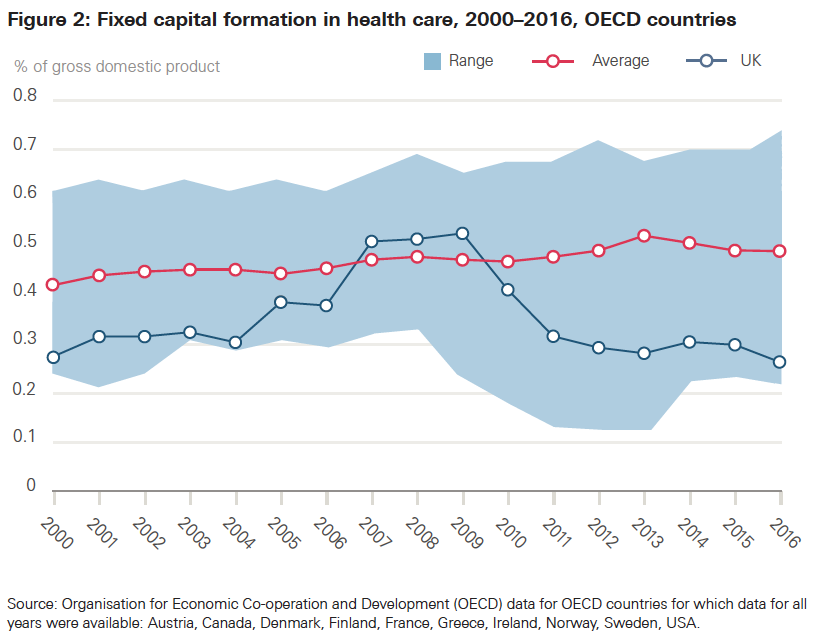
We can compare the NHS to other health systems in how it allocates money to the things that should matter to future productivity. The easiest to measure is capital spending. And, mirroring the problem with spending in the economy as a whole, the big picture looks to be a catastrophe of poor short term choices (for a more detailed analysis see my longer rant here). In an analysis in 2019, the Health Foundation produced this chart:


And said:


"Capital spending is a critical input in health care, with new technology able to transform services and improve workforce productivity. 


The DHSC has proposed a more technology–and data–driven NHS. New technology and IT could improve patient services and increase productivity, but both currently make up a small proportion of capital spending."


So, not only does the NHS get starved of capital spending in general but the mix is very light on the things that would typically have the biggest impact on productivity.


The result of this is that the capital employed per worker (an interesting measure of the stock of things that partly determine productivity) is half that of most comparable systems. 


And, according to the National Audit Office, even when the NHS gets allocated a capital budget, it frequently either underspends it or pilfers it in year to cover operating deficits. This is a perfect illustration of the political choice to take an easy path rather than the right one. And one that has, in effect, killed the hope that NHS productivity could improve enough to lower the financial burden on long term government spending. And this has been the chosen path for two decades. It is little wonder that the productivity of the NHS is falling and that the system is creaking under the strain. 


Some conservative commentators are now arguing that the government can no longer afford to keep spending more, as they need to do to stop the wheels from coming off the bus. But those commentators ignore a major  reason for the current need for more spending: the neglect of any attempt to spend the money on the long term things that would make the NHS much more productive and reduce the pressure to spend more to avoid imminent catastrophe. 


And the opposition don't help pull the debate back to solid ground by claiming everything is about staff shortages. There are two problems with this. One is that investment in better equipment and facilities could improve productivity so much the need for more staff could be reduced. The other is that the biggest reason staffing is a problem is not recruitment, it is retention and a large part of that is caused by the poor working environment some of which is caused by the lack of capital per worker. And the constant churn of staff, especially when experienced staff are replaced by cheaper but less capable staff, undermines team productivity and quality, exacerbating the need for yet more staff in some sort of anti-productivity death spiral.


So what?

And this brings us back to why the NHS is a microcosm of the economy as a whole. In order to attempt a rescue of government finances ravaged by the Kwarteng mini-budget, the key proposals to recover the government deficit currently being discussed are to cut things that are easy to cut quickly. Like capital spending. So, instead of spending on the long term things that enhance future productivity, they are likely to cut them further and in ways that damage the very growth they seek. They should have learned from the Osbourne era that that does not work. The easy path then–capital austerity–hurt the national growth rate and made it harder to fund the sorts of spending the government cannot cut if they don't want to lose their core voters (are they going to cut pensions when the most conservative block of voters are pensioners? I don't think so).


As Martin Wolf said in a recent column in the FT (my highlights):


The UK’s longer-term economic performance must indeed improve if the desires of its people for a better life are to be realised. If the government wants to do something useful about this, it might dust off the report of the London School of Economics’ Growth Commission of 2017. Better incentives are indeed a part of the answer, but only a part. This is why systematic tax reform would be desirable. There must also be difficult deregulation, notably of land use. The state must supply first-class public goods, in the understanding that these are a social benefit, not a cost. There must be fiscal and monetary stability. There must be far higher investment in physical and human capital, both public and private.


Neither the economy nor the NHS will be better tomorrow if the investment in the long term is cut. The persistent habit of picking easy cuts rather than the right cuts is a recipe for long term catastrophe (and possibly short term catastrophe too). 


Spending the money well (especially not neglecting long term investment) is the solution to the growth and productivity problem in the NHS and the wider economy. Spending it badly by making easy choices now is not.


PS that cartoon is modified from an original by the late great B Kliban. See some of his other quirky cartoons here: https://www.gocomics.com/kliban


Thursday, 7 April 2022

We are having the wrong debate about modelling the NHS workforce

It sounds intuitive that having a good model of the NHS workforce would be useful for solving many observable problems in the current NHS. But there are reasons to assume any such model would not be as useful as expected and could even be harmful. More importantly, the starting point suggested for the model is wrong in multiple ways that almost certainly guarantees the model would fail to solve the real problems.


When I first heard that a coalition of Labour MPs and the ex-NHS SoS Jeremy Hunt were proposing an amendment to the Health Bill to insist on regular publication of a workforce model for the NHS, I thought the idea was a good one. Better, transparent information about the staffing needs of the future NHS sound like a useful idea to test against government policy. 


But, when I reflected on some of the issues I have seen in the past when Strategic Health Authorities did workforce plans I started to have doubts. Then, after some further conversations and cogitation, those doubts grew. Considered alongside my analysis of what the biggest challenges are for the NHS (in short, the front line workforces is far from the biggest problem), my skepticism strengthened. 


So, I'm going to argue that, while a good workforce plan might help, the one we are likely to get is likely to be somewhere between useless and harmful. It is starting in the wrong place, has unclear goals that will likely make it far less useful than expected and has some risk of making things worse. 


That's a big claim. Let me walk through the potential issues I see step by step. 


Where the workforce model might go wrong


It doesn't start by considering productivity


The starting assumption in the debate is the almost universal belief that the problem is a shortage of front line staff. Commentators observe busy A&Es, overwhelmed GPs risking staff burnout, hospitals where waiting lists are growing not falling, and leap to the conclusion that the only way to address these is more medical staff.


But the problem framed this way distracts from any analysis that concludes anything other than "more staff" can influence the amount of work done. Concluding that only more staff matters rules out many known interventions that should be part of the debate, especially those that improve productivity..


Here is a simple example. NHS A&Es are currently catastrophically crowded and patients are getting treatment so slow it is killing them. But we know from analysis that has existed since the 4hr target was introduced that the number of A&E doctors has very little influence on the speed (for a fun review of the evidence on this and how little appetite the system has to listen to it read this BMJ piece and the replies). The dominant cause of long waits in the last decade has been slow access to free beds for admitted patients. The problem isn't even inside the A&E, so adding more A&E staff won't fix it. To be fair, the workload needs in A&E do increase sharply with the length of the queue. But they don't help to make the queue shorter. So any workforce model that ignores the external factors causing the queue will end up recommending far more A&E staff than needed if the external bottleneck causing the queue is ever solved.


Another example shows that not thinking more widely about the mix of staff required is a major problem in planning. A Royal College of Surgeons blog reported in 2017 that the productivity of surgeons had declined sharply as their numbers rose because numbers of support staff and nurses had not risen. It reports "Between 2010 and 2016, consultant numbers rose by 22%, compared to just 1% for nurses and 2% for all staff."  It Also pointed out that "... consultants in hospitals that invested more in infrastructure and building … are more productive". (it is worth reading the original analysis by the Health Foundation as well for much more detail). So, is a workforce model is built to forecast the number of surgeons required, but ignores the number of nurses and support staff or the capital required to create a productive theatre, it will vastly overestimate the number needed.


The point is that productivity depends on the mix of staff and other factors like equipment. Driving higher output across the NHS requires a good understanding of where the bottlenecks to productivity are so the right mix of capital and people can be deployed. Adding more of the most visible front line staff is often not that effective. But it is what a "more resources to the front line" workforce model is likely to achieve.


It is unclear what decisions a long term workforce model is intended to support


The only point of any model is to support better decisions. If you are vague about what decisions, then the model is likely to be unhelpful and even misleading. 


So what decisions could a long term workforce model support? So far the discussion has tended to focus on the need for a model to inform the NHS about its workforce need in 5, 10 or 15 years. 


What decisions could such a model influence? Not many. If we know we need more nurses in 5 years time the NHS might just have enough time to increase the number of training places to increase the numbers qualifying in 5 years time. But it is unclear whether increasing the number of doctors in training right now would lead to higher available numbers in a decade's time. 


If the NHS is short of particular skills right now, it is unclear how a long term model can possibly help. What the system needs most urgently is some idea of what the options are today


If the model focuses–as much of the discussion about it has–on front line staffing need, then it also misses critical groups that contribute to the productivity of the front line (see the section on productivity for why this is important). The question that desperately needs an answer is what different mix of staff, equipment, buildings and new clinical processes would give the biggest increase in the number and quality of treatments delivered. Many of those questions are not workforce questions at all and even a workforce-only model needs a good understanding of how different staff interact to make the front line more productive. That understanding will only come from a significant piece of careful analysis that doesn't seem to exist. 


What the NHS needs right now is that analysis. It needs to know where the bottlenecks to higher activity are. It needs to know what mix of capital spending, front line staff, support staff and managers would lead to the largest improvement. Without that a workforce plan will be about as useful as a one-legged trapeze artist with an itchy bum.


A workforce model designed to tell the system how many staff it needs to put into training now will get the wrong answer because it ignores all the interactions and other factors that matter and, even if that wasn't true, could not influence any decision that will have an effect for 5-10 years at best.


Major factors that influence the workforce today are likely not part of the model


The NHS has a workforce problem right now. And many of the factors causing problems are not relevant to the long term supply of qualified staff. Or anything else likely to appear in the proposed workforce model.


Right now the biggest factors influencing staffing gaps are recruitment problems and high turnover (plus illness, if temporary pandemic-specific problems count). These problems don't just affect the front line staff groups but are common in the other groups where a lack of staff has a lot of leverage over front line productivity.


There are many causes of recruitment problems and high turnover. In some groups NHS pay is inadequate compared to other jobs the same staff can do. This is a big issue for nurses but a huge problem for support staff like data scientists. It is also a bigger problem in some geographies like London where the cost of living is much higher and there are more alternative well-paid jobs. But the NHS finds it almost impossible to flex salaries to retain the people it needs both because the pay scales are national and because some groups are vastly undervalued in AfC grading compared to the market.


Working conditions are also a huge factor for recruitment and turnover. If the space is badly adapted to the work being done (~14% of buildings predate the NHS!) then the environment will be poor. Badly maintained buildings add to this (the maintenance backlog is about £10bn). Old, shonky equipment is slower and harder to use than modern equipment. IT systems are often slow and not seamlessly integrated so staff waste time waiting to log on or logging in to a dozen separate systems to complete a clinical task. Front line staff end up spending too much time doing tasks that should be done by support staff or managers (where staffing levels have been cut to "put more staff on the front line") instead of caring for patients. 


Too much of the people management in the NHS is bad. Staff are treated badly and insensitively by managers but also by senior doctors and nurses (the Ockenden report didn't just blame "staff shortages", it clearly blamed senior staff of all professions for ignoring clear signals about problems and even suppressing whistleblowers). 


Very few, if any, of the factors that discourage recruitment and drive high turnover are part of any proposed workforce model.


So the model won't tell the NHS whether a big increase in capital spending, creating better buildings, equipment and IT systems, would yield rapid gains in a better working environment. Nor will it conclude that recruiting more support staff to enable the front line to focus on treating, rather than admin paperwork, would improve their job satisfaction. And nobody in NHSE would allow the model to conclude that salary flexibility might yield immediate benefits in both lower turnover and higher recruitment rates.


That means that the model is likely to have nothing to say about the major factors that could impact the workforce any time in the next 5 years. What was the point of it again?


A long term workforce model risks fossilising current mistakes and practices


More than a decade ago I was part of a team auditing some workforce models for SHAs (when they still existed). One of the problems the team spotted was that complex models with very large amounts of detail tended to be very hard to audit properly and often contained errors in their code. That's bad when you rely on their outputs. 


But that complexity also had a side effect that is, though not an error, worse: they fossilised current assumptions about the mix of the workforce. In particular, they made assumptions about the need for very small specialist subgroups of staff (humorously like the number of orthopaedic surgeons specialising in only left hands). The problem is that practices often change faster than the model. So, if the model spits out the demand for some small highly specialised group in a decade's time, it may have been overtaken by major changes in the way that specialty works. Once upon a time, for example, most cataract operations were done under general anaesthetic. Then it became obvious that local anaesthesia was faster and safer and the mix of activity changed rapidly. Any model built before that change was obvious would forecast a completely incorrect mix of staff or number of staff.


When you build complicated models there is always a big risk that the assumptions in the model persist long after the change as many models are even harder to update than clinical practice. Or the modellers just don't notice the changes and the NHS keeps relying on their model as the users of the model don't understand it well enough to understand the assumptions it makes.


In another case I studied a model built for NICE on staffing in A&E departments (see my commentary). The original report gained a lot of credibility when NHSE allegedly suppressed it. But it was leaked alongside the full documentation on a simulation model built by external consultants that had been a major evidence source for their recommendations. I read the documentation. I wept. The assumptions about how an A&E worked had almost no relationship to reality and ignored very clear, well-known, data about actual performance. It looked like it had been built by someone who had never visited a real A&E or mapped a real world operational process. I suspect that most people who read the report didn't understand the model or that it was a major part of the evidence behind the recommendations. But bad models make bad recommendations. Worse, complex models make those mistakes harder to spot.


Even when a model works it may fail to influence the right decisions


The debate about the need for an NHS workforce model seems to assume that models have a magical ability to change the decisions people make. Decision scientists know this isn't true. 


Many analyses and models completely fail to influence actual decisions even when they are reliable and the data behind them is correct. For example, the NHS has reported on the hospital maintenance backlog for years, including an estimate of the need for urgent action to limit the immediate risk to patients. Yet decision makers have repeatedly chosen to spend far too little on capital (the budget has been about half that of peer health systems for most of the last two decades). And the high risk maintenance budget backlog grows every year. Maybe bad decision making is very resistant to modelling or analytical data.


Models work best not when they give a highly specific and precise answer but when they help decision makers to understand the core issues behind the decisions they have to make. A complex and detailed model of the NHS front line workforce is unlikely to achieve this. Not least because, if its focus is just the front line, it will fail to help decision makers to understand the tradeoffs involved in between different decisions they could make today.


What if, for example, a small increment in the number of managers greatly improved the productivity and quality of the work done in hospitals? How would that choice interact with the future needs for front line staff? We already know that more managers do have significant effects (see this summary from the NHS Confederation) but the idea that a workforce model should think about them is entirely absent from the current discussion on workforce modelling.


Also missing in the discussion on workforce modelling is any hint of how capital spending on better buildings, equipment or IT could contribute to productivity. But decision makers have to make tradeoffs today about how to split the budget among front line staff, support staff (including managers) and capital spending. And for most of the last decade that choice has skewed towards the front line leaving the NHS with a chronic deficit of support staff, managers and adequate modern buildings and IT (for some data see my analysis here). Those choices have led to declining front line productivity, a much worse working environment and, arguably, contributed to recruitment problems and higher staff turnover. A model focussed just on the long term needs for front line workforce numbers will encourage continued neglect of those other factors which directly impacts the immediate workforce.


Conclusion: a long term workforce model is a distraction not a solution


It seems obvious that the NHS has a serious shortage of front line staff. But that observation is very deceptive. It is a symptom of widespread problems of productivity and blocked flow of patients. As with many medical conditions, there is a strong temptation to treat the symptom and assume that this cures the disease. In NHS language, focussing on the front line workforce assumes that investment in the front line workforce cures the problem. But, like trying to cure headaches caused by a brain tumour with stronger painkillers, treating the symptom doesn't solve the underlying problem.


A model that assumes that frontline overload is cured purely by adding more staff distracts attention from all the other factors causing overload of front line staff. So attention will be distracted from inadequate buildings, obsolete equipment, slow and badly designed IT, admin overload caused by a lack of support staff and managers, and poorly designed clinical pathways. And "more staff" doesn't fix problems where the issue is having the wrong mix of staff. 


Some of those problems might be fixed, in principle. We could, perhaps, build a model that takes into account the staff mix, not just the overall number of staff. It could even highlight the areas where extra staff would most improve overall productivity (eg, to fix A&E overload, invest in staff who can improve the flow through beds). Unfortunately the first step would be to develop an analysis of how the whole system fits together and therefore identify which incremental investments would most improve the productivity of the system. There is no such analysis, though there are plenty of hints that workforce isn't the biggest problem. 


The workforce model as currently discussed seems likely to further distract the NHS from other major problems. A focus on the front line risks distracting from even bigger staff shortages behind the front line. And from a long term neglect of capital spending (leading to major issues with buildings, equipment, and IT). Furthermore there is a big risk that a long term workforce model could ignore the short term decisions that might help the immediate problems with workforce and could encourage the NHS to build in false assumptions that fossilise bad current choices.


That's a lot of risks for an unclear outcome. Whatever the intuitive attraction of a transparent model of workforce needs, it is far from obvious that the NHS would get anything useful.


We need a more informed debate about what holds back NHS productivity, not a model focussed on the front line workforce.