Pages

Showing posts with label budget. Show all posts

Thursday, 31 March 2022

The biggest problem holding back NHS performance is a lack of investment in capital, innovation and management not staff or beds

In debates about what the NHS should do to improve its performance it is common to see benchmarks of staffing or bed numbers versus comparable health systems. The argument is that the system needs more doctors/nurses/beds. This is not the biggest problem. The NHS has suffered far more from a failure to invest in capital, innovation or management. 


Charts like the one below dominate the debate about NHS funding:
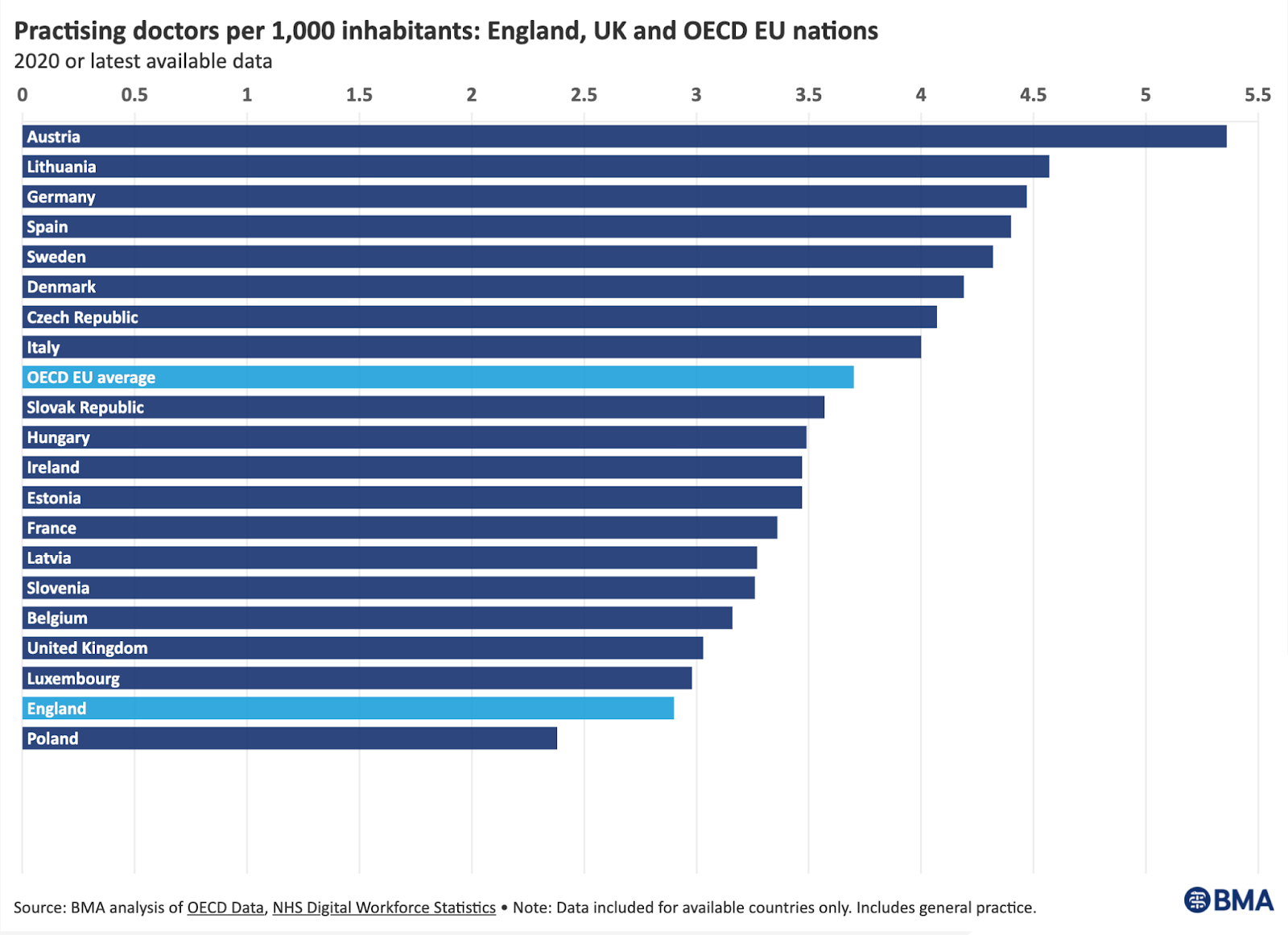

The message is simple: the NHS is underfunded and needs to have more doctors (or nurses or more money, depending on which lobbyist is producing the charts).


The implication is that the very obvious performance problems of the system would be solved if only we matched the same level of doctors/nurses/funding as the peer group of other health systems.


There is some debate on the strict comparability of these metrics and that is rarely mentioned by the lobbyists. In fact I once saw Nigel Edwards heckled for pointing out that a major revision on OECD metrics of overall spend on the NHS and comparable systems made the NHS look middling rather than an outlier on the low side. People really want the explanation for poor NHS performance to be simple and, preferably, a conspiracy they can blame on the Conservatives. It is frequent to see phrases like "Tory staffing cuts".  And that is the end of the debate for many.


But, even though the overall NHS budget saw unusually low growth in the decade after 2010, front line staffing increased significantly. The "tory cuts" in staffing led to ~30% more doctors and 15% more nurses:


I don't want to argue that the government is not to blame. I do want to argue that we are looking in completely the wrong place about where policy has been wrong.


There are far, far bigger problems than not having enough front line staff. And the real problems that front line staff experience are often consequences of those other failures. Worse, those other failures get almost no attention and the topics that do get attention distort the debate so much that the biggest and most important failures get essentially no critical attention.


Before I get to the other issues that I argue matter more than staffing, it is worth a quick review of why the staffing benchmarks are not that relevant to NHS performance.


One reason is a lack of strict comparability with the other countries in how they use staff. But a more interesting one is that the implied policy when it looks like the NHS is behind ("fix the staffing, fix the problem") very clearly doesn't work in specific cases. An example is A&E staffing. It has been repeatedly claimed in the last decade that the decline in A&E performance is a consequence of a lack of A&E staff. But the number of A&E doctors rose faster than demand every year since 2010 and the number now is >30% higher than it was in 2010. The number of A&E specialists grew faster than any other for most of the last decade. But performance has declined monotonically over that period. 


In this case it is easy to see why staffing was never the problem. Patients suffer long waits in A&E not because there are not enough A&E staff to treat them but because there are no free beds to move the patients to. This was known in the early 2000s when the 4hr target was set and has repeatedly been shown in detailed analysis of the causes of waits in the last decade (see, for example, this from Monitor). To put it simply, more A&E doctors can't magic up more free beds. They mostly can't even influence the number of free beds. So adding more staff doesn't fix the underlying problem. (I should add that the longer the A&E queue, the more staff are needed to handle it. So the apparent staff shortages are actually a symptom of a different problem elsewhere in the hospital, not the cause of the problem. Adding more doesn't fix the problem.)


So what other errors has the NHS made?


The NHS benchmarks that really matter


Let me tell you the answer before working through the details and arguments. 


The NHS might be slightly short of front line staff but it is catastrophically short of support staff like managers and has a long standing lack of investment in innovation and capital spending. If benchmarks versus comparable health systems are any guide, the NHS is a spectacular outlier in investment and management. 


The NHS is very undermanaged


When the Lansley Reforms were in draft form and proposed severe cuts in management numbers there were several analyses that criticized this goal. The King's Fund concluded as part of its commission on leadership and management that:


"If anything, our analysis seems to suggest that the NHS, particularly given the complexity of health care, is under–rather than over–managed."


And this was before the drastic cuts in the Lansley reforms were implemented (see the staffing chart above for their immediate impact). A more recent analysis (in a report by Ian Kirkpatrick and Becky Malby for the NHS Confederation) said:


"...it is hard to argue that the NHS is ‘overmanaged’. At approximately 2 per cent, managers are a very small proportion of the NHS workforce. By comparison, ‘managers, directors and senior officials’ in the UK as a whole make up 9.5 percent of the workforce." 


And, in another report in the series they argued this: 


"We found that even a small increase in the proportion of managers employed (from 2 to 3 per cent of the workforce in an average acute trust) had a marked impact.


Up to a certain point, larger management functions in trusts were associated with higher patient satisfaction scores, a 5 per cent rise in hospital efficiency and a 15 per cent reduction in infection rates. Further tests revealed that it was primarily higher levels of managers employed that drove these improvements and not the other way round."


Both NHS management numbers and total administration costs are far below international norms and have fallen sharply since 2010. Given the clear evidence from Kirkpatrick's work that more managers make hospitals function more effectively, cutting management looks like a bad error. Adding more managers has a lot of leverage over the performance of all the other staff but the NHS has chosen to cut their numbers instead.


Both manager numbers and total administrative costs are far more out of line with international norms than the number of doctors, nurses or beds. Although good comparable metrics are hard to find, the IFS claimed this in 2018:


The OECD has compiled data on administrative costs of different health care systems at the ‘macro’ level – which captures the amount spent on planning, funding and monitoring care, but not administrative costs within individual hospitals. 


They found that the NHS spends relatively little on overseeing and planning care, relative to other comparable systems. In 2014, the UK, Portugal and Ireland all devoted 1.5% or less of their government or compulsory health care expenditure to administration. This compares with an average of 3.1%, with 4.1% in France, and 7.9% in the United States.


Investment in innovation and capital is grotesquely low 


Another area where the NHS is an outlier is spending on capital and innovation. In fact it is an extreme outlier.


This is somewhat ironic given Rishi Sunak's recent spring statement where he diagnosed a major problem for the UK economic productivity as being largely caused by a lack of investment in innovation and capital. As he argued:


"Over the last fifty years, innovation drove around half the UK’s productivity growth.


…our lower rate of innovation explains almost all our productivity gap with the United States.


Right now, we know that the amount businesses spend on R&D as a percentage of GDP is less than half the OECD average.


Weak private sector investment is a longstanding cause of our productivity gap internationally:


Capital investment by UK businesses is considerably lower than the OECD average of 14%.


And it accounts for fully half our productivity gap with France and Germany."


The NHS is the largest part of the UK economy controlled by the government. So exactly how has the government sought to control its spending on the key factors that determine productivity in the rest of the economy? 


It won't surprise you to know that it is the opposite of the Sunak recipe for productivity in the private sector.


The Health Foundation did a (little read) briefing on this in 2019. It starts by pointing out the obvious:


"Capital spending is a critical input in health care, with new technology able to transform services and improve workforce productivity. 


The DHSC has proposed a more technology–and data–driven NHS. New technology and IT could improve patient services and increase productivity, but both currently make up a small proportion of capital spending."

So the DHSC has an ambition to exploit technology and IT (which needs investment). But the Health Foundation analysis of 20 years of NHS capital spending compared to peer health systems looks like this:
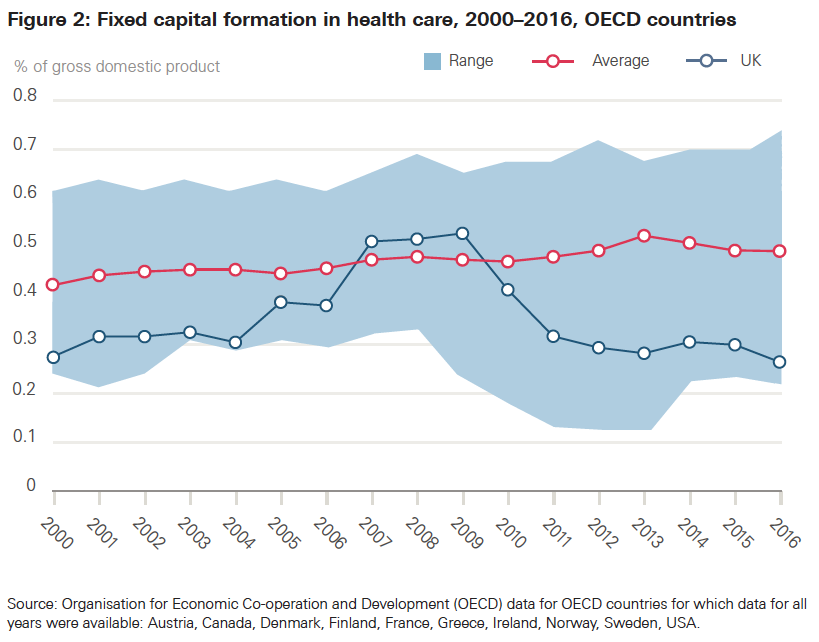
Only during the late Blair/Brown years did NHS capital spending come close to international norms and it is often the lowest or next to lowest in the whole dataset. The Health Foundation  argue:


"For the UK to move up to the average for OECD countries, capital spending would have to almost double as a share of total health spending"


The National Audit Office also reviewed capital spending in the NHS in 2020 and some of their analysis tells an even more sorry tale. 


They start by pointing out part of the current situation with buildings and other capital assets:


Parts of the NHS estate do not meet the demands of a modern health service. NHS hospitals include Victorian-era buildings, and 14% of the NHS estate predates the formation of the NHS (1948). 


The growth in backlog maintenance indicates that there is an increased risk of harm to patients … the backlog of maintenance work to restore buildings to an appropriate standard was around £6.5 billion … High-risk backlog maintenance currently stands at £1.1 billion, and grew by 139% between 2014-15 and 2018-19, indicating an increased risk of harm to patients.


It isn't just the lack of modern IT and diagnostic equipment that holds back the NHS. It needs more modern buildings to do a good job but frequently doesn't have them.  Worse, in some cases, maintenance problems in the existing buildings are so bad they risk immediate harm to patients.


Given this already disturbing background it might be a surprise when they point out that in many years of the last decade the already inadequate capital allocation to the NHS was underspent:


"Between 2010-11 and 2012-13, there was an average underspend of £677 million (12%) against the capital spending limit. In 2017-18, £360 million (6%) was unspent."


And their story gets worse:


"Since 2014-15 the Department has transferred £4.3 billion from capital to revenue spending"


So not only does the NHS start with an inadequate budget, which it underspends, it is then encouraged to pilfer the capital budget to cover operating costs. The reason this has been encouraged is because it is a convenient short term way to cover up operating deficits. These are embarrassing. And, obviously, avoiding embarrassment is more important than the roof of an operating theater falling in. Better still, while operating deficits are visible every year, most of the catastrophes from the maintenance backlog will appear slowly over a decade.


It might seem strange that the inadequate capital budget should ever be underspent. But the NAO explain that too by pointing out that the paperwork and bureaucracy of applying for capital is so baroque that many hospitals can't even get their cases for urgent maintenance past the system. And, even if they do, they might lose the allocation if they can't spend the money in-year as next year's allocation may be arbitrarily different. Short term changes to the budget every year make long term planning of capital spending impossible.


The buildings are inadequate for modern healthcare activities. There is a huge and rising backlog of maintenance to keep the show on the road that is limiting the capacity of the system to do more work. The system frequently steals from capital to employ more staff who will have to work in an environment where their work will be harder and less productive. The NHS is close to bottom on international rankings of the amount of high-tech equipment it needs to do the diagnostics necessary to tackle long elective queues. And there is little budget for investing in better IT to enable front line staff to work faster and more productively without the burden of coping with decade-old kit.


It is lucky that investing in capital or innovation doesn't matter for productivity. Oh, wait, that's exactly what the chancellor blamed for low productivity.


As an ironic coda to this section the following story appeared in the HSJ the day after his spring statement:


"Tech spend under pressure as NHSE told to ‘cut core funding’"

It hasn't taken long for the promises in the last spending review to invest more capital in the NHS to hit the buffers of old Treasury munchkin habits.


The government's goals for an improved, more productive NHS are directly undermined by its choices about how to allocate resources.

There are several important messages here.


Problem 1: the government itself has correctly argued that spending on capital and innovation are vital for driving up productivity. So much so that they are increasing the incentives to encourage more such spending in the private sector. But, when they control the budget, they do exactly the opposite. And, at the same time, continue to demand even higher productivity gains from the NHS. Whipping a dead horse doesn't cover it. It is more like whipping the reliquary containing the ashes of the horse cremated a decade ago after being euthanized for breaking a leg.


The second huge problem here is the lack of attention this analysis has had among commentators and the media. The news is full of stories about how the NHS is struggling because it has 10 or 20% fewer doctors than comparable systems. Lobbyists for nurses and doctors demand higher levels of staffing to fix the overwork, the current catastrophic waiting lists and A&E delays. But there is little mention of the fact that the NHS has perhaps half the capital employed per worker than almost any other health system. The NHS is a far more extreme outlier on this than it is on staffing. And the day to day work the front line staff have to do is much harder and less productive as a result.


The third problem is management. NHS management does make the news more often than capital spending, but almost always to disparage it. Stories often argue that we could cut management even further to put more resources to the front line. These stories usually fail to note that NHS management has already been sharply cut by the Lansley reforms and is currently another major outlier in comparisons between the NHS and other systems (I made the case about managers and their importance in the NHS here). Nor do they mention that very clear work shows that more managers make productivity and medical quality better. 


In short, there is a fundamental mismatch between the government goal for a more productive NHS and the way it provides the tools to the NHS to achieve that productivity. The government and NHSE are like an army who recognises the need for bullets but forgot to allocate a budget for the guns required to fire them. 


The perpetual failure to invest enough in capital, innovation or management is a far bigger problem for the NHS than any shortage of staff. It is about time the commentariat, the media and the government realized this. We won't fix the NHS until they do.


Tuesday, 5 October 2021

GP prescribing is one of the few areas of NHS spending that is under control

Last week the government released a report on overprescribing that suggested perhaps 10% of prescriptions issued by GPs were unneeded or harmful. The media headlines tended to frame this as another reason to attack GPs. The Telegraph, for example, had this headline: "GP's needless prescriptions push drugs bill to £9bn…"


This framing was wrong but also led to a huge story being missed and an important lesson being ignored.


While GP overprescribing is a problem that deserves to be tackled, it is a far smaller problem than hospital prescribing and is already being tackled (for example, the report highlights the campaign against antibiotic overprescribing in the mid 2010s that led to substantial reductions). 


The GP prescribing budget is one of the few areas of NHS spending that has been under control. It has been between £8bn and £9bn for longer than a decade and has shown as many falls as rises year on year. Overprescribing by GPs is not driving spending up.


Hospital prescribing, on the other hand, has risen from £4.2bn in 2010/11 to £11.7bn in 2019/20 and is rising at a rate of between 8% and 16% every year (see the NHS Digital data here:https://digital.nhs.uk/data-and-information/publications/statistical/prescribing-costs-in-hospitals-and-the-community/2019-2020 ). See the chart: 


(the numbers above the bar are the annual growth rates in the spending)


This is out of control and, unlike GP prescribing, is a big problem.


We have a good idea why one budget is under control and the other is not. Detailed data about what is happening in GP prescribing in England is available and has been public for more than a decade. Analysts like me can count the number of prescriptions for, to give an example, 20mg simvastatin pills, in every GP practice every month. This hugely rich dataset covering more than a billion annual prescriptions can be interrogated to reveal the differences among practices for every one of the 20 or 30 thousand items they can prescribe (Oxford's EBM Datalab even provides a free interactive tool allowing anyone to analyse the data: https://openprescribing.net/ ).


We don't yet have anything like that for hospital prescribing (the Datalab is working on one but it isn't complete). For many years the only source the NHS had was data bought from an external firm which had restrictive clauses preventing detailed use or dissemination of the numbers (that external firm's primary purpose for collecting it was to sell it on to the pharmaceutical industry for sales analysis, not to help the NHS get a grip on its spend). The NHS has no mandatory collection of data that would give it the same level of insight it already has for GP prescriptions.


Given how little we know about hospital prescribing, there is little mystery why the budget is out of control (and rapidly approaching 10% of the whole NHS budget). When the NHS has exquisitely detailed data about what is happening it can get a grip on both quality and spending; when it doesn't, the budget is out of control and the system has no idea about the quality. For all we know hospitals are wasting gargantuan amounts of money and overprescribing on a massive scale.


We should be praising GPs running one of the most well-managed areas of NHS spending. And we should be scandalised, instead, by the NHS's failure to collect the data necessary to get a grip on out of control prescribing by hospitals. That's what the headlines should have been last week.


Friday, 18 March 2016

The government approach to cutting costs is the worst way to achieve lower costs


Governments love to distribute the pain of budget cuts evenly by slicing a percentage from every department's budget. This seems fair but is the worst way to achieve sustainably lower spending or to minimise the damage caused by the cuts.


The trouble with government is that it is run by politicians. And politicians usually care more about image than they do about substance when it comes to making decisions. So when public finances are squeezed they tend to focus on the fairness of their budget cuts rather than the effectiveness of their budget cuts and this sometimes leads to really dumb decisions.


To do a good job of cost cutting or improving efficiency you need to know where and how the money is being spent now. For example, if you run a factory and its costs are way higher than the competition, it helps to know in detail why that is the case. It could be you have a serious problem with overmanning; or it might be that the skill mix is wrong and you need higher quality, more productive people; or, it might be that you need more people because the machines they work with are unreliable and old; or perhaps you buy all the raw materials from low quality, expensive suppliers. If you don't know which problem you have, cutting the budget might make things worse not better. If your problem is obsolete machinery, for example, the best fix is to invest in new machinery (which involves spending more); short term cuts to the maintenance budget will, ultimately, lead to less reliability and higher costs.


If the first thing you cut is the accounting and analysis department (they don't produce anything, do they?) then you will not be able to diagnose why your costs are high and therefore tell which action is most important for the long term future of your factory. You will most probably make the wrong decisions.


This is a pretty good analogy for how governments cut public spending.


The ONS, for example, is responsible for gathering and analysing the statistics that tell us what is happening in our economy, but they haven't been doing a good enough job (see BBC story or this story in Public Finance ). But government has been cutting their budget and doing crazy things like moving their headquarters to Newport from London (which saved costs by ensuring that most of their experienced staff resigned to stay in London leaving the organisation with a huge experience deficit and a much reduced capacity to do its job).


The NHS as a whole has done relatively well compared to most other government departments with its total budget. But inside the NHS a similar pattern emerges.


NICE is responsible for evaluating the quality and cost effectiveness of drugs and procedures in the NHS. But it is facing significant budget cuts even though spending more might identify more opportunities to save costs and improve quality across the whole NHS. But we can't have more spent on analytics when there are squeezes on providers, can we? That would be unfair.


The new NHS Improvement is supposed to work alongside NHS providers to help them do a better and more efficient job of caring for patients. There is a strong case for doing more to identify good practice and help spread it across the system. But one of the barriers to achieving improvement is a serious lack of reliable data about how the money is spent now and, in many providers, how the staff are deployed. The Carter review of the opportunities for NHS savings was very clear on this (see this analysis). And it isn't as if the current archaic infrastructure of collecting data in the NHS is good enough to support improvement at any level (see this comment). But NHS Improvement is going to have to live with significant headcount cuts when it is finally officially established. Apparently it needs to send a signal to providers about the fairness of the NHS financial squeeze. And that is, apparently, more important than its ability to do a good job of supporting the NHS to improve.


And it isn't as if hospitals will be expanding their information departments in the current climate even if doing so might help them achieve improvement elsewhere. Cutting already inadequate information teams is easy as it doesn't affect patient care tomorrow (and if it is catastrophic for care in a couple of years, who is going to care as the Chief Executive will have moved on by then?)


If you don't understand how things work, arbitrary cost cutting will lead to long term damage


If your approach to cost cutting involves slicing the ends of everything that looks like a salami then you will also cut the ends off a lot of fingers.


In one of the very few good books on business strategy, Richard Rumelt argues that the first step in any effective strategy is a good diagnosis of the problem you are trying to solve (see this interesting analysis of how his thinking applies to the NHS). The current symptom we observe in the NHS is large financial deficits. But this isn't the problem any more than a fever is a problem for a patient with malaria. To understand what the actual problem in the NHS is we need to know where and how the money flows. If we don't understand what is happening to create deficits then we can't develop a coherent plan to create an NHS that can sustainably treat patients without lapsing into periodic financial catastrophe. We can treat a fever with an ice bath, but if we don't understand what caused it (was it malaria or was it viral pneumonia?) the patient's recovery will be brief and the fever will soon return.


I don't want to try and diagnose the underlying problems of the NHS in a short blog article; my point is merely that a salami slicing approach to budget cuts damages the system's ability to do diagnosis. This is especially true when the cuts affect the flow of information or the bodies with the expertise to analyse problems and develop improvements. The NHS has tended to grossly undervalue good, timely operational information and is severely short of the analytical capacity to make sense of that information (for examples see this on A&E data and this on the information infrastructure).


The Carter report on hospital productivity argued (see my analysis) that the biggest barrier to improvement was a lack of good information about operational performance. But the we-must-share-the-pain-equally, salami-slicing model of addressing the current deficits is cutting the capacity to collect and analyse that information even though that capacity was inadequate to start with.


We won't build a sustainable NHS without a good diagnosis of the underlying problems. That requires better information about what is happening inside hospitals. A good strategy for achieving a sustainable NHS would, therefore, focus on getting better information at the start so subsequent decisions could address the most important underlying problems.


What we are likely to get is more salami-slicing which damages our ability to understand the problem and exacerbates the failure to focus on which problems matter most. In fact NHS strategy is still in an era equivalent to medicine when bleeding patients with leeches was still thought to be a good universal cure. As in medicine, repeated application of the leeches will fail to cure the patient. Whatever the apparent short term gain, in the long term the patient will be sicker.


The problem generalises across all of government. Salami-slicing cuts to everyone's budget damages the government's very ability to know what is actually happening and therefore its ability to make good decisions about what really ought to be done.


It looks like the patient with the fever is stuck in the ICU until someone comes up with a better diagnosis.


Sunday, 22 November 2015

NHS capital to revenue transfers make things look better but reinforce the underlying problems

The NHS has found a way to make the ongoing deficits in trusts seem less awful. But looking less bad isn’t the same as fixing the problem and what is happening now reinforces the worst failures of the NHS. Here is why.


Deficits in NHS hospitals this year have already reached £1.6 billion which is the worst they have been for a very long time. This is clearly worrying.


The leadership has decided to take decisive action. The HSJ reports a comment from Paul Briddock of the Healthcare Finance Management Association:


“It seems that both Monitor and the TDA are trying to work locally with FTs and trusts to make capital to revenue transfers. They are asking trusts to consider scaling back their capital expenditure plans, releasing the cash that was previously going to be spent here to support the cash shortfalls being driven by their income and expenditure deficits.”


In other words the decisive response from DH, the TDA and Monitor is to fiddle the accounts to make things look better and damn the effect on making the long term much worse.


This is a major worry as the “fix” reinforces one of the worst habits the NHS exhibits when spending money. The system is far too focussed on the short term and neglects the allocation of money to the things that would lead to long term, sustained improvement in operational productivity and quality. Here is an analogy:


You run a factory that makes widgets. Your factory has a dodgy leaky gas supply and old electrical wiring which sparks a lot. Fires are common, cause lots of damage and cost a lot to put out. And, obviously, fires cause factory closures and get in the way of your ability to make more widgets. You can’t currently make enough widgets to meet the demand, which is insatiable.


Your budget is under pressure. Perhaps the source of the problem is that, although widget making looks profitable, this assumes the factory doesn’t break down or incurr extra costs like paying firefighters.


The board of your firm decides that the response is to cancel the capital programme of fixing the gas leaks and rewiring the building. So you can have enough cash this year to pay the firefighters when they come to fix the increasing number of fires. And you can still show a surplus even when the factory keeps breaking down.


Exactly when do you realize this is perpetual madness? But it is (however imperfect the analogy) exactly what the NHS is doing. And has done in the past even when there was plenty of money sloshing around the system.


The NHS could be improved in big increments by careful spending on the right things. Buildings could be better designed to support staff and current treatment processes (there are still many pre-NHS facilities). Better equipment could deliver cheaper, more reliable diagnoses and treatments. Most importantly (and most neglected) better information systems could provide the information required for the multiple staff who interact with patients to deliver coordinated care (the organisation-focussed idea of integrated care is faintly ludicrous as most single NHS organisations can’t coordinate the care inside their own walls because their systems for managing patient information are so poor). Most hospitals don’t have reliable information to tell them whether alternative ways of organising their care yields better efficiency or quality.


Many of those improvements depend on capital spending, which has been neglected in the past and is being postponed now to make a superficial choice between making things look good rather than actually making them good. The NHS can't improve unless it spends on the long term things that enable that improvement. That's what capital spending should be about.


This problem is greatly exacerbated by the NHS’s general suspicion of management. Managers are often thought of as either useless bureaucrats or actively harmful parasites. And the desire of politicians to seek attractive headlines rather than effective action reinforces the problem (as I’ve argued here). The reality is that the NHS is so undermanaged that, some commentators put it (quoted on the flipchartfairytales blog), if it were a charity:


Our own position is that we wouldn’t want to support an organisation spending less than 5% of its total expenditure on good management. Without this we would lack confidence that the objectives of the organisation would be achieved.”


The NHS spends something like 30% of that metric.


It doesn’t fill me full of confidence that the latest plans of the leadership of the NHS are focussing on making the superficial accounts look better rather than making a case for the capital spending on long term improvement and the management capacity to identify the key requirements and ensure the spending delivers the improvements.

I’d rather see the NHS facing a major short term crisis than see it reinforce the worst habits that have led to its current position.